
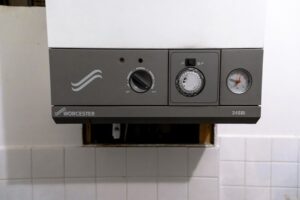

Worcester boiler error codes are the boiler’s way of flagging a fault, and while some are easy to sort yourself, others mean you’ll need to pick up the phone and call a Gas Safe engineer.
Most people only think about their boiler when it stops working, usually on a cold January morning when the heating refuses to come on. If you’ve got a Worcester Bosch boiler and there’s a flashing light or a strange code on the display, this guide is for you.
This article walks you through the most common fault codes, what’s actually causing them, and what you can realistically do about it without making things worse.
Worcester boiler error codes appear on the display panel when the system detects a fault. The most common issues are low water pressure, ignition failures, sensor faults, and problems with the condensate pipe. Some codes clear themselves after a simple reset or pressure top-up. Others point to a component failure that only a qualified engineer can safely fix.
What the display is actually telling you
Worcester Bosch boilers use a letter-and-number system to communicate faults. Older models may use a flashing LED sequence instead of a digital readout, but the principle is the same. The code narrows down where the fault is coming from, which saves engineers time and saves you money on diagnosis.
Here is a breakdown of the most common codes homeowners encounter:
EA 338 relates to an ignition fault. This means the boiler tried to fire up and failed. It could be a gas supply issue, a faulty ignition lead, or a problem with the gas valve itself.
A1 indicates low water pressure. This is one of the most common codes and often the easiest to fix yourself. Your boiler needs to sit between 1 and 1.5 bar at rest. If it drops below 0.8, the boiler will lock out.
E5 points to an overheating fault. The boiler has got too hot and shut itself off as a safety measure. This can be caused by a blockage in the system, a failed pump, or air locks in the central heating system.
E9 is a safety thermostat fault. This is a more serious one and you should not attempt to reset it repeatedly without getting it checked. It usually means something is genuinely wrong with how the boiler is managing heat.
C6 relates to the fan speed. The fan is either running too slowly or not at all, which affects how the boiler vents combustion gases. That’s a safety issue and needs an engineer.
D5 is a condensate fault. This is common in winter. The condensate pipe is the plastic pipe that carries waste water from the boiler, and it often runs outside or through an unheated space. When temperatures drop, it freezes and the boiler locks out.
F7 points to a flame detection fault. The boiler lit but the sensor didn’t pick it up correctly. This could be a dirty or faulty flame sensor.
How to fix the common ones yourself
There are a handful of fault codes where you can take some action before calling anyone.
Low pressure (A1): Find the filling loop under the boiler. It is usually a silver braided hose with a valve or two at each end. Open the valves slowly until the pressure gauge reads around 1.2 bar, then close them and reset the boiler. If the pressure keeps dropping, you have a leak somewhere in the system and that needs investigating.
Frozen condensate pipe (D5): This is particularly common in UK winters. The pipe is usually white or grey plastic and runs outside the property. Carefully pour warm, not boiling, water over the pipe to thaw it. Work from the boiler end outward. Once thawed, reset the boiler. If it freezes again regularly, the pipe may need insulating or rerouting.
General reset: Most Worcester boilers have a reset button, often marked with a flame symbol or a circle with a line through it. Hold it for a few seconds. If the fault clears and the boiler fires up normally, great. If it locks out again within a few hours, you are masking a real problem and should get it looked at.
When you should not attempt a fix yourself
Some Worcester boiler error codes are a clear sign to step back and call a professional.
If you are seeing E9, C6, or any code related to gas supply or heat exchanger faults, do not keep resetting the boiler hoping it clears. Repeated manual overrides on a safety fault can create a dangerous situation. Gas appliances in the UK must be serviced and repaired by a Gas Safe registered engineer. This is not just a recommendation, it is the law.
If the boiler is making unusual noises alongside an error code, that combination usually means a component is failing or has already failed. Kettling, banging, or gurgling sounds alongside an error code are a sign the fault is more than minor.
Also, if you are seeing the same code appear every few days even after resets, that pattern suggests a component is on its way out. Catching it early tends to be cheaper than waiting for a full breakdown.
Cost of repairs: what to expect in the UK
This is where it gets real. Call-out charges for gas engineers in the UK typically range from £60 to £120 just to attend and diagnose. That is before any parts or labour on the actual repair.
For common faults, here is a rough idea of what repairs cost:
Pressure-related repairs including a new filling loop or fixing a small leak tend to come in around £80 to £150 all in, assuming nothing major is wrong.
A new condensate pump or fixing a frozen condensate pipe setup, including better insulation, might cost between £100 and £200 depending on access and parts.
Ignition-related repairs such as replacing an ignition lead or electrode typically cost between £100 and £250 depending on the engineer and the part.
Fan replacement is one of the pricier common repairs, often coming in between £200 and £400 because the part itself is not cheap.
A faulty PCB, the main circuit board, can cost anywhere from £300 to £600 or more when you factor in parts and labour. At that price point, it is worth getting a quote alongside a boiler replacement quote, especially if the boiler is over 10 years old.
If you are on a boiler cover plan, check your policy. Many cover call-outs and parts, which makes error codes considerably less stressful to deal with.
Mistakes homeowners make when dealing with error codes
The biggest one is the repeated reset. Most people’s first instinct is to reset and hope for the best, and that works fine for minor blips. But resetting a boiler that has a genuine safety fault over and over is not a solution. It delays the repair, potentially causes more damage, and in rare cases, can be dangerous.
Another common mistake is assuming the boiler is completely broken when it locks out. A lockout is actually the boiler doing its job correctly. It is protecting itself and your home. The code is a clue, not a death sentence.
People also overlook the basics. Checking that the gas supply is on (other gas appliances working?), checking the pressure gauge, and checking whether the thermostat is set correctly will solve a surprising number of issues without any tools at all.
One thing most people overlook is getting the boiler serviced annually. A serviced boiler is less likely to throw fault codes in the first place because engineers catch small issues before they become big ones. It also keeps your warranty valid if the boiler is relatively new.
Preventing fault codes from appearing in the first place
Annual servicing is the single best thing you can do. Worcester Bosch recommends yearly servicing, and most reputable engineers will check the heat exchanger, burner, sensors, and condensate system as part of a standard service. Expect to pay between £80 and £120 for a boiler service in most parts of the UK, though it can be higher in London.
Keeping an eye on the pressure gauge is a good habit. Check it once a month during winter. If it keeps dropping, there is a slow leak somewhere that needs sorting before it causes a more expensive problem.
Insulating the condensate pipe before winter arrives is a simple step that prevents one of the most common lockout calls engineers receive between November and February.
Bleeding your radiators regularly helps maintain efficiency and prevents airlocks that can contribute to overheating faults. If several radiators are cold at the top, that is a sign air is trapped in the central heating system.
Finally, if you notice a change in how your hot water and heating performs, a loss of pressure, strange noises, or longer warm-up times, do not wait for a fault code to appear. Getting ahead of problems is almost always cheaper than waiting for a full lockout.
Read more: How to bleed air from a Worcester Bosch boiler
Worcester boiler error codes are genuinely useful once you understand what they are pointing to. The boiler is not being awkward; it is telling you something is off. For low pressure and frozen pipes, you can often sort things yourself in ten minutes. For anything involving the gas supply, heat exchanger, or safety thermostats, call a Gas Safe engineer. The cost of a proper repair is nearly always less than what happens when a small fault is ignored long enough to become a serious one.