The majority of homeowners consider their geyser twice: once upon moving in and once upon its malfunction. That makes sense. On a Tuesday morning, when the shower is hot and life is fine, there’s really no reason to think about it. It works silently and sits in a cabinet or up in the ceiling.
Geysers are problematic since they don’t offer you much notice before things go awry. You frequently have to pay for repairs or, worse, water damage from a slow leak that went unnoticed for weeks by the time you realize something is wrong. Homeowners who grasp the fundamentals prior to a crisis, rather than during one, are typically the ones that avoid the worst of it.
What you really need to know as a homeowner is covered in this guide. Not only what a geyser is, but also how to properly size one for your home, what settings really matter, which warning indicators are important to watch out for, and what your obligations are in terms of upkeep, insurance, and compliance. Because geysers in South Africa face a different set of difficulties than those covered by most generic web literature, it is written specifically for South African settings.
The Real Operation of a Typical Electric Geyser
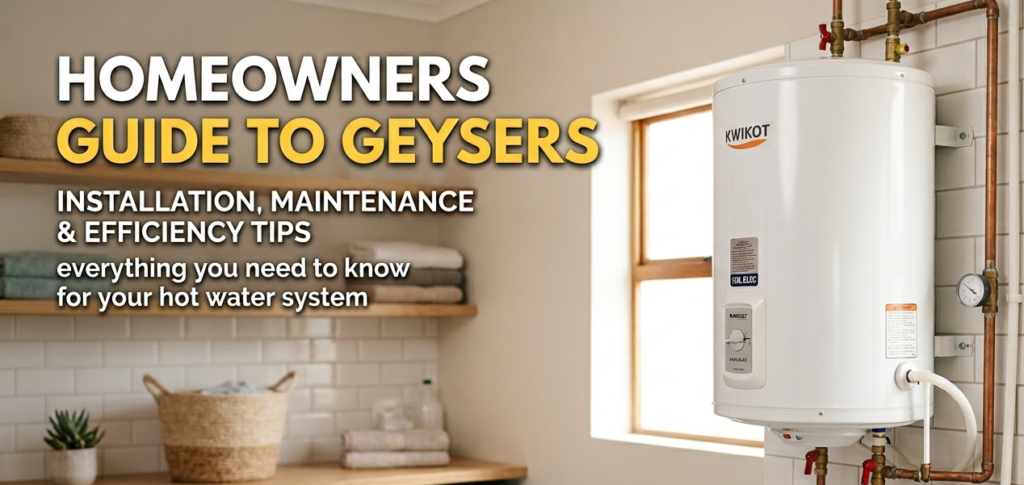
Understanding what’s happening inside the unit is helpful before anything else. A typical electric storage geyser is an incredibly basic piece of machinery. Fundamentally, it’s a steel tank, often 100 to 200 liters, that contains water and uses an electrical heating element—similar to the one in a kettle, but bigger and more durable—to keep it at a predetermined temperature.
The entrance pipe allows cold water to enter the tank from the bottom. When you turn on a tap, the warmest water naturally gathers at the top of the tank and leaves through the outlet pipe because the element heats the water and hot water rises. This also explains why the water cools down when you run a lot of hot water at once and why the first water out of the tap is typically the hottest. Cooler water is pushing in from the bottom of the tank to replace the water you are pulling from the top.
The part that instructs the element on when to turn on and off is the thermostat. If you set it too low, the water will be lukewarm and may contain bacteria. If you set it too high, you’ll waste electricity boiling more water than you need and put undue stress on the fittings and tank.
A safety feature installed on the side or top of the device is the pressure valve, often known as the T&P valve or temperature and pressure relief valve. If the temperature or pressure inside the tank becomes dangerously high, it is responsible for releasing the water. This valve is telling you something if it has been leaking for some time or is continuously dripping. It’s okay to disregard it and “get to later.”
The drip tray is attached to a drain and is located underneath the geyser. Its purpose is to collect water from the pressure valve discharge and to stop early leaks before they cause structural or ceiling damage. Even a tiny leak can be unnoticed until it becomes a major issue if your drip tray drain is plugged.
These are the essential elements. When anything starts acting weirdly, it’s far simpler to figure out what’s going on if you know what each one does.
Choosing the Right Geyser Size for Your Home
Installing the same size unit that was previously there without first determining if that size is appropriate for the home is one of the most frequent errors made when replacing a geyser. Replacing a 100-liter unit with another 100-liter unit won’t help if your family of five frequently runs out of hot water by the time the third person takes a shower.
Most installers utilize 40 to 50 liters of geyser capacity per household member as a general guideline. A 100-liter unit is usually plenty for a childless couple. A larger household of five or six people would benefit more from a 200-liter unit or two smaller units put in parallel, whereas a family of four will typically require 150 liters.
Usage trends are just as important as population size. The size of the heating element and tank capacity are important since your geyser must recover rapidly between uses if everyone takes a morning shower in a small timeframe. There is a trade-off when it comes to your electricity expenditure because a larger element boils water more quickly but requires more current.
Think about the source of the hot water in the house as well. A significant quantity of heat is lost in the pipes between the unit and the taps when a single geyser serves the kitchen or bathroom at one end of the home and the main bathroom at the other. Longer pipe runs result in increased heat loss, longer hot water wait times, and greater operating expenses. It is frequently wiser to install a second, smaller unit near the farthest point of use in large homes rather than enlarging the primary geyser.
Geyser Location and Why It Matters More Than Most People Realize
The location of your geyser has an impact on its longevity and performance. The best location is closest to the faucets that use the most hot water, which are typically found in the main bathroom. The water loses more heat before it gets to you the farther it must go through uninsulated pipes.
Although ceiling installations are common in South African homes, they have certain practical disadvantages. It is more difficult to gain access for maintenance and inspection, and ceiling damage might occur more quickly than you might anticipate before anyone notices. If your geyser is located on the ceiling, make sure the drain pipe and drop tray are in good shape and that the tray isn’t damaged or obstructed.
Adequate ventilation is necessary wherever the unit is placed, especially for heat pump units that take air from the surrounding area. A geyser in a small, sealed cupboard with little airflow is exerting more effort than necessary, which will shorten its lifespan.
Geysers are also more vulnerable to temperature fluctuations due to uninsulated roof areas and sun-facing external walls. Uninsulated pipework in a cold roof area can become a serious issue during a cold winter in Johannesburg or the Karoo, but it is acceptable for a ceiling space to get very warm during a hot summer on the Highveld. Even pipes that don’t freeze lose a lot of heat overnight in cold weather, and frozen pipes are uncommon in much of South Africa but not unheard of in higher-altitude regions.
The Thermostat Setting That No One Really Discusses
The majority of geysers are delivered from the plant at temperatures between 65 and 70 degrees Celsius. That’s generally where you want to be, but rather than just leaving it where it was set when the unit was installed, it’s important to understand the reasons behind it so you can make an informed choice.
Bacterial control is the primary justification for maintaining the thermostat at 60 degrees or above. Temperatures between 20 and 50 degrees Celsius are ideal for the survival and growth of the Legionella bacteria, which causes Legionnaires’ illness. The suggested minimum range for stored hot water is 60 degrees since water that is continuously kept above that temperature kills the bacteria.
It makes sense to lower the thermostat to save power, but anything below 55 degrees starts to pose a serious health risk, especially in homes with young children, the elderly, or persons with weakened immune systems. The risk is not worth the savings.
Anything above 70 degrees on the upper end is essentially superfluous for residential use. It puts more strain on the thermostat and element, speeds up the accumulation of scale inside the tank, raises the possibility of scalding, and increases maintenance costs. There’s no legitimate reason to operate your thermostat at 80 or 90 degrees.
For most homes, 60 to 65 degrees is the ideal temperature. Not too hot to waste energy or put undue strain on the components, but hot enough to be safe.
Homeowners Can and Should Perform Their Own Maintenance
Keeping an eye on your geyser doesn’t require you to be a plumber. Any homeowner may perform a few checks without coming into contact with any electrical or pressurized equipment.
Regularly check the drip tray for standing water, which indicates a leak or excessive discharge. It is usual to occasionally leak a tiny amount of water from the pressure valve. It’s not consistent water in the tray.
Examine the pipes around the unit for indications of corrosion, rust stains at joints, or dampness on pipe surfaces. These frequently indicate that something has to be fixed during the upcoming service, but they don’t always indicate that something is about to fail.
While the geyser is heating, listen to it. A low hum is typical. Heavy scale accumulation inside the tank is typically indicated by loud popping, pounding, or a continuous rumbling during the heating cycle; this is especially common in locations with hard water. In addition to decreasing efficiency, this can harm the element if it persists long enough.
Examine the pressure valve discharge hose, which should connect the valve to an external drainage point or the drip tray. It shouldn’t be directed into a closed area, blocked, or capped. A hazardous pressure scenario is created when this conduit is blocked.
A professional is needed for two maintenance tasks in addition to these visual and auditory inspections: changing the anode rod and flushing the tank to eliminate sediment. The tank’s lifespan is significantly increased by the sacrificial anode, an aluminum or magnesium rod inside the tank that corrodes in place of the steel tank walls. The majority of manufacturers advise changing it every three to five years. One of the main reasons geysers fail early is because very few homeowners are aware of it.
Cautionary Signs You Shouldn’t Ignore
Before they fail, geysers often present warning signs. Most people make the error of believing that those signals are insignificant or that the issue would remain unchanged. Most of the time, it becomes worse.
Water that takes longer to heat than it used to typically indicates a malfunctioning element or a large accumulation of scale surrounding the unit, which lowers the element’s efficiency. It may also be a sign that the thermostat is no longer precisely maintaining the desired temperature.
The thermostat is probably malfunctioning or the element is beginning to fail if your shower runs hot, then abruptly becomes cold, and then recovers again without you making any changes.
One of the more alarming indicators is rust or brown-tinted water. It shows internal corrosion, which could be caused by a failing anode rod, corrosion in the pipes, or internal corrosion in the tank itself. When rust appears in the water, the tank is nearing the end of its useful life.
A pressure valve that drips continuously. The valve is intended to open in unusual circumstances. The tank’s internal pressure is frequently higher than it should be if it is continuously leaking water. This can indicate a malfunctioning expansion vessel, a broken valve that has to be replaced, or an overheated thermostat.
Even a slow, continuous flow from a little crack or failing joint will eventually result in significant structural and ceiling damage. **A damp ceiling or water discoloration surrounding the unit. Take immediate action if you see any discoloration or sagging in the ceiling beneath or surrounding a geyser.
Comprehending SANS 10254 and Your Compliance Responsibilities
SANS 10254, the national standard for the installation, upkeep, and repair of home water heating systems, must be followed for any geyser replacement or installation in South Africa. This is not optional, and the installer is not the only one who must be concerned. It is your responsibility as the homeowner to comply.
A drop tray with a drain, a pressure limiting valve, an expansion relief valve on the cold water inlet, a vacuum breaker, and the appropriate pressure and temperature relief valve for the unit are all required by this standard for all new geyser installations. A certificate of conformity must be produced and maintained, and the work must be completed by a licensed plumber.
What occurs when you have to file an insurance claim is a practical reason to be concerned about this in addition to the legal necessity. Geyser coverage is typically included in home insurance policies, although the fine print frequently stipulates that the installation must adhere to the applicable SANS standards. Your insurer has the right to deny a claim if the installer of your geyser took shortcuts and omitted necessary parts. No one wants to have that chat after a ceiling has been destroyed by a ruptured geyser.
Ask specifically if the price includes a certificate of conformity and all necessary fittings when you receive quotations for a replacement. Not all contractors will provide this data voluntarily. The homeowner frequently doesn’t find out which certificate they have until something goes wrong, and some will supply it, while others won’t.
The Impact of Load Shedding on Your Geyser
Since generic geyser recommendations don’t handle this South African issue, it’s important taking immediate action. Electric geysers are impacted by load shedding in two distinct ways that are important to comprehend.
The power spike that occurs when the energy is restored after an outage is the most pressing problem. The geyser element draws its maximum current when the supply is restored in order to heat water that has cooled during the outage. This kind of heavy load cycle accelerates the element’s and thermostat’s wear over time. Geysers in South Africa often fail earlier than their theoretical lifespan would indicate, in part because of this.
It is sense to run a geyser through a surge protector or have a licensed electrician verify that the circuit breaker and wiring are appropriately rated for the unit. This is especially important for older installations where the wiring may not have been inspected in a while.
To prevent the heating cycle from being constantly interrupted, you can set geyser timers, which let you schedule when the unit warms, to coincide with load shedding patterns. If you’re on a time-of-use pricing structure—which some towns now use—you also avoid paying peak electricity costs.
When to Replace and Repair
Generally speaking, a geyser that is younger than seven or eight years old and develops a repairable fault—such as a broken element, a malfunctioning thermostat, or a malfunctioning pressure valve—is worth fixing. After the problem is fixed, the tank should continue to function for several more years because it is still in reasonable condition.
A separate computation applies to a geyser that is more than ten years old and develops a problem. An older unit’s repair costs typically range from 30 to 50 percent of the price of a new installation. That money is being spent on a unit that might fail once more in a year or two. A replacement frequently makes more financial sense, especially when you consider the efficiency improvements of a newer unit, unless the defect is minor and the repair cost is modest.
A tank failure is the lone exception to this reasoning. There is no way to fix a tank that has rusted through, fractured, or is leaking from the unit’s body rather than a fitting or valve. It is necessary to replace the geyser. A home geyser tank cannot be properly patched or welded, and anyone who implies differently should be viewed with extreme skepticism.
What Your Home Insurance Doesn’t Cover and What It Does
Geyser failure is covered by the majority of basic house insurance plans in South Africa, although the specifics differ greatly between insurers and policies. Instead of thinking you are completely insured, it is worthwhile to examine the terms of your insurance.
Coverage usually covers: unexpected and sudden damage to the geyser itself; water damage to ceilings, walls, and floors as a result of a geyser burst; and, in certain situations, the expense of temporary housing if the damage renders the property uninhabitable.
Policies typically exclude the following: wear and tear (an element that failed due to age and scale, for example, may be treated as wear and tear rather than sudden damage), gradual damage that developed over time and wasn’t reported, damage brought on by neglect, and anything pertaining to non-compliant installations.
Before continuing to offer coverage, some insurers now demand that geysers older than a specific age be examined or replaced. Some give you a discount if you install a heat pump or solar geyser. When you next review your insurance, it’s worthwhile to question your insurer about both.
Take pictures of your geyser installation, the drip tray, the valve arrangement, and the compliance certificate and save them in a convenient location. This is a useful, free step. Having records of the installation’s state prior to the failure is helpful if you ever need to file a claim.
A Useful Schedule to Adhere to Every Year
No one is advising you to think about your geyser for a long time. However, a quick yearly inspection just takes fifteen minutes and can identify issues early enough for inexpensive repairs. This easy practice is recommended implementing once a year, preferably prior to winter when system demand rises:
Look for any indications of corrosion, rust stains, or dampness in the vicinity and beneath the geyser. Verify that the drain pipe is clear and look for any standing water in the drip tray. When the unit is heating up, listen for any strange noises. Look for any indications of corrosion or weeping in the pipe connections that are visible. If you know when the unit was installed, take note of its age and consider it when deciding whether to replace or repair it if something goes wrong.
It is important to have a licensed plumber evaluate the geyser if it is older than seven years. Not because something is certainly wrong, but rather because a professional eye will notice things that a homeowner could miss, and it is nearly always less expensive to identify a malfunctioning anode rod or a valve that is beginning to fail before it becomes a catastrophe.
A geyser is one of the most expensive appliances in your house to replace when something goes wrong, despite the fact that it is not a difficult piece of technology. Homeowners that pay a little attention to their units on a regular basis, understand what they’re looking at when they do, and don’t wait until the ceiling is wet to start asking questions are nearly invariably the ones who get the most out of them and spend the least on unplanned repairs.
Geyser Insider has comprehensive guides on gas geysers, solar options, heat pumps, common faults, costs, and everything else that influences that decision, whether you’re currently dealing with a specific geyser issue or attempting to determine which kind of replacement makes the most sense for your home.