
Geyser prices are one of those things most South African homeowners only start researching when something has already gone wrong. The old unit gave up, the plumber is on his way, and suddenly you are standing in a hardware store or scrolling frantically through Builders Warehouse trying to figure out how much you are about to spend.
It is not an ideal situation. Whether you are replacing a burst geyser, upgrading to something more energy-efficient, or building a new home and making decisions from scratch, knowing what each brand costs and what you actually get for that money can save you a lot of stress and quite a bit of money. This guide breaks down the South African market honestly, including what drives the price differences between brands and where it is and is not worth spending more.
Quick Overview: What Affects the Price?
Before getting into individual brands, it helps to understand why one geyser can cost R2,500 and another can cost R18,000. The price difference usually comes down to a few things: the type of unit (electric, solar, or gas), the capacity in litres, the brand reputation and warranty period, the quality of internal components like the element and thermostat, and whether it comes with a pressure control valve or any installation accessories. A basic 100-litre electric geyser from a budget brand will obviously cost a fraction of a 300-litre solar system from a premium manufacturer. Neither is automatically the wrong choice. It depends on your household size, your budget, and how long you plan to stay in the property.
Electric Geysers: The Most Common Choice
Most South African homes run on standard electric geysers, and this is where the widest range of brands and prices exists.
Kwikot
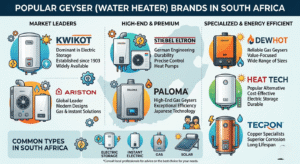
Kwikot is probably the most recognised name in South African geyser manufacturing. They have been around for decades and supply a large portion of the residential market. Their standard electric geysers typically range from around R2,800 for a 50-litre unit up to R5,500 or more for a 200-litre model. One of the reasons plumbers tend to recommend Kwikot is that spares are easy to find and most technicians know the units inside out. The warranty is generally five years on the tank, which is decent for the price range. That said, the units themselves are fairly basic in terms of design and energy efficiency. You are not getting anything fancy, but you are getting reliability and good parts availability.
Franke (FMB)
Franke electric geysers sit in a similar price range to Kwikot, typically between R3,000 and R6,000 depending on size. The quality is comparable, and they are well regarded in the trade. Spares are generally available, and the tanks come with reasonable warranties. For most straightforward replacement jobs, Franke is a solid, mid-range option that does not require you to make much of a case for or against it.
Ariston
Ariston is an Italian brand with a fairly strong presence in South Africa. Their electric geysers tend to cost a little more than the local manufacturers, usually sitting between R4,000 and R8,000 for standard residential models. The build quality is generally considered slightly better, with better insulation reducing heat loss and therefore running costs. If your electricity bill has been bothering you, an Ariston with improved insulation can make a meaningful difference over a few years of use. Their warranty terms are competitive, and the brand has good distribution throughout the country.
Bosch
Bosch geysers are positioned at the upper end of the electric market in South Africa. Prices for their electric units typically range from R5,000 to R10,000, depending on capacity and the specific model. The German engineering reputation carries weight here, and the units tend to be well built. However, when things go wrong, finding a technician who is familiar with the specific model can sometimes be harder than with locally manufactured brands. Parts can also take longer to source. This is not a dealbreaker, but it is worth knowing before you buy.
Chromagen
Chromagen is an Israeli brand that has carved out a decent share of the South African market, particularly for solar and combination systems. Their electric geysers are priced similarly to Bosch, between R4,500 and R9,000 for most residential sizes. They are known for decent build quality and a reasonable warranty. Chromagen is probably more commonly associated with solar water heating, but their electric units are worth considering if you can find a supplier nearby.
Rheem
Rheem is a well-known global brand with a presence in South Africa. Their electric geysers generally range from R4,000 to R8,500. Quality is solid, and the units are built to handle the demands of South African water conditions reasonably well. They are not always the easiest to find in smaller towns, so availability might be a factor depending on where you live.
Solar Geysers: Higher Upfront, Lower Running Costs
Solar water heaters have become increasingly popular in South Africa, partly because of load shedding making people think more carefully about their energy reliance, and partly because Eskom tariffs keep climbing. The upfront cost is significantly higher than a standard electric geyser, but the ongoing savings can be substantial.
Chromagen Solar
Chromagen is one of the leading solar geyser brands available in South Africa. A standard flat-panel solar system with a 150-litre tank typically costs between R8,000 and R14,000 for the unit alone, before installation. Evacuated tube systems tend to cost a little more but perform better in overcast conditions. Total installed cost often sits between R12,000 and R22,000 depending on the setup and whether a backup element is included.
Solsquare
Solsquare is a locally developed solar geyser brand that has grown in popularity over the past decade. Prices are competitive, often slightly lower than Chromagen, with systems ranging from around R7,500 to R15,000 before installation. Many homeowners appreciate the local support network and the fact that parts are easier to source domestically.
Kwikot Solar
Kwikot has extended their range into solar, which makes sense given their strong distribution and familiarity in the trade. Their solar systems are priced in a similar bracket to Solsquare. The advantage is that plumbers already familiar with Kwikot products can often service the solar units with less difficulty.
Bosch Solar
Bosch offers solar water heating systems in South Africa, typically at the higher end of the market. Expect to pay R12,000 to R20,000 for the unit before installation. The quality is high, but so is the price, and the same parts availability issue that applies to their electric units applies here.
Ariston Solar
Ariston also offers solar options locally, generally priced between R10,000 and R18,000 for the unit. Their heat pump models, which are increasingly popular as an alternative to traditional solar panels, typically cost between R12,000 and R22,000 installed. Heat pumps are worth considering if your roof does not get enough direct sunlight or if you want a simpler installation.
Gas Geysers: Practical During Load Shedding
Gas instantaneous water heaters have become a genuinely practical option for South African homes dealing with frequent power cuts. They heat water on demand and do not require electricity to operate.
Paloma
Paloma is one of the most widely available gas geyser brands in South Africa. A standard residential unit typically costs between R3,500 and R7,000 depending on the flow rate (measured in litres per minute). They are reliable, widely serviced, and parts are generally available.
Rinnai
Rinnai is another strong player in the gas market, with units ranging from around R4,000 to R9,000. They are known for durability and consistent performance. Many plumbers prefer Rinnai for gas installations because of their reliability record.
Bosch Gas
Bosch also manufactures gas geysers available in South Africa, typically priced between R4,500 and R8,500. The quality is good, but again, parts availability and service network are factors to consider.
Dewhot
Dewhot is a budget-friendly gas geyser option available from retailers like Builders Warehouse and Game. Prices typically start at around R2,500 and go up to R5,000. For rental properties or situations where you want something functional at a low cost, Dewhot is worth looking at. The quality is not comparable to Rinnai or Paloma, but for occasional use, it does the job.
What People Overlook When Comparing Prices
Most people compare the unit price and forget about installation. This is usually where things get expensive. Installation costs in South Africa vary quite a bit depending on your location, the type of unit, and the complexity of the job. For a standard electric geyser replacement in the same position as the old one, expect to pay between R2,000 and R4,500 for labour. If you are relocating the geyser, adding a drip tray, upgrading the pressure control valve, or working with a solar installation that involves panel positioning on the roof, costs climb quickly.
There is also the question of the electrical certificate of compliance, which is legally required after certain installations and typically costs an additional R700 to R1,500. Many homeowners only find out about this when the work is already done.
Another thing most people overlook is the cost of ancillary components. Pressure control valves, vacuum breakers, drip trays, and insulation blankets are sometimes not included in the listed geyser price. These can add another R500 to R1,500 to the total job. Always ask your plumber for a fully inclusive quote before work starts.
Common Mistakes When Buying a Geyser
Buying the wrong size is probably the most common mistake. A 100-litre geyser might seem fine for a household of three, but if everyone showers in the morning, you will run out of hot water daily. A general rule is 50 litres per person in the household for standard electric storage geysers. A family of four typically needs at least a 150-litre unit, and larger households benefit from 200 litres or more.
Another mistake is choosing a brand based purely on price without checking parts availability in your area. A cheap geyser from an obscure brand might save you R1,000 upfront but cost you much more when the element fails and no local supplier stocks the replacement.
How to Choose the Right Unit for Your Home
Start with your household size and hot water usage pattern. If your family all showers at different times throughout the day, a smaller unit with a faster recovery rate might work fine. If mornings are chaotic and everyone needs hot water at once, go bigger. For homes with regular load shedding, a gas unit or a solar system with a gas or electric backup element is worth serious consideration. For rental properties or budget-conscious situations, a reputable mid-range electric geyser from Kwikot or Franke does the job without unnecessary expense.
Cost Summary by Category
To give you a clear picture of what geyser prices look like across the market:
Electric geysers (unit only) range from roughly R2,500 for budget or smaller capacity models up to R10,000 for premium brands in larger sizes. Solar systems typically cost between R7,500 and R22,000 for the unit, with total installed costs often between R12,000 and R30,000. Gas instantaneous heaters generally run from R2,500 to R9,000 for the unit, with installation usually between R2,500 and R5,000 depending on gas line complexity. Heat pump water heaters are a growing category, typically priced between R12,000 and R25,000 installed, offering significant electricity savings over time.
Installation on top of any of these adds R2,000 to R5,000 for a standard job, more for complex setups.
At the end of the day, there is no single brand that is right for every situation. Geyser prices tell part of the story, but the real decision comes down to your household’s needs, how much you are willing to spend upfront versus save on running costs, and how easy it is to get service and parts in your area. The brands covered here all have their strengths. The most expensive option is not always the best one for your specific situation, and the cheapest option is not always the worst. Take your time, get a few quotes, and make sure whoever is doing the installation is a registered plumber.