
Solar geyser prices have become a serious topic in South African households over the last few years, and honestly, it’s easy to see why. Between load shedding, rising electricity costs, and Eskom tariffs that seem to go up every other month, people are actively looking for ways to cut down on what they spend heating water. A geyser is one of the biggest electricity consumers in any home, often accounting for 30% to 50% of your monthly electricity bill. So the idea of switching to solar makes a lot of sense on paper.
But here’s the thing most people don’t know going in: the upfront cost can be surprising. And not just the unit itself. There are installation fees, extras you didn’t budget for, and decisions you need to make about the type of system that actually suits your home. This guide breaks all of that down so you know exactly what you’re getting into before you call a plumber or sign anything.
Quick answer
A basic solar water heating system in South Africa typically costs between R8,000 and R25,000 installed, depending on the type of system, the size of your household, and who does the installation. Premium systems with larger tanks or evacuated tube collectors can run from R25,000 to R40,000 or more. That’s a significant outlay, but most homeowners start seeing savings within two to five years.
What a solar geyser system actually involves
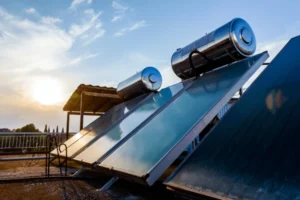
A solar water heater is not quite as simple as people expect. It’s not just a tank on the roof. The system typically includes a solar collector (the panel part), a storage tank, connecting pipes, insulation, mounting brackets, and some form of backup heating for cloudy days.
There are two main configurations you’ll come across:
Direct (open loop) systems circulate household water directly through the collector. These are simpler and cheaper, but they’re not great in areas with hard water because limescale builds up inside the collector.
Indirect (closed loop) systems use a heat-transfer fluid (like glycol) in the collector and transfer that heat to your water through a heat exchanger. These cost more upfront but last longer and handle hard water better.
You’ll also choose between two collector types:
Flat plate collectors are the most common and affordable. They look like a dark metal panel on your roof and work well in most South African climates. A decent quality flat plate system usually runs between R8,000 and R18,000 installed.
Evacuated tube collectors are more efficient, especially in areas with less consistent sunlight or colder winters. They’re also more expensive. Expect to pay anywhere from R15,000 to R35,000 for a complete installed system. Some high-end setups push past R40,000.
Solar geyser prices: full cost breakdown
Here’s a realistic look at what you’ll pay in South Africa for a solar geyser. Keep in mind that prices vary by region, supplier, and installer.
The unit (equipment only):
- Entry-level flat plate systems (100 to 150 litre): R5,000 to R10,000
- Mid-range flat plate systems (150 to 200 litre): R10,000 to R18,000
- Evacuated tube systems (150 to 200 litre): R14,000 to R30,000
- Premium or larger capacity systems: R25,000 to R50,000+
Installation costs: Installation usually adds R3,000 to R8,000 on top of the equipment cost. This covers labour, connecting pipes, mounting the collector, modifying your existing plumbing if needed, and installing the backup element. If your roof requires significant structural work or you need new pipes run from scratch, that number can climb.
Additional costs most people overlook:
- A SANS 10106 certificate of compliance (often required by municipalities and insurers): R500 to R1,500
- Replacing old geyser infrastructure like burst pipes or aged valves: R500 to R3,000
- Electrical work for the backup element: R800 to R2,500
- Drip trays, pressure valves, and safety fittings: R500 to R1,500
When you add it all up, a realistic all-in budget for a properly installed mid-range system for an average South African home (three to four people) is somewhere between R18,000 and R28,000.
How the installation process works
Most installations take one to two days if there are no complications. Here’s roughly how it goes:
First, a plumber or solar installer assesses your roof, existing geyser setup, and water pressure. They’ll check whether your roof can handle the added weight and whether the orientation is suitable. South Africa’s roofs generally face the right direction for solar, but shading from trees or other structures can reduce efficiency significantly.
The old geyser may be repurposed as the storage tank (especially on retrofits), or a new tank is installed. The collector panels are mounted on the roof, pipes are connected, and a backup electrical element is installed for days when there’s not enough sun.
After installation, the system should be commissioned and tested. The installer should also register the installation with the municipality if required. This matters more than people think, because unregistered installations can affect your home insurance.
Common mistakes homeowners make
Buying too small a system. A 100-litre tank sounds like enough until you have guests or run multiple hot showers in the morning. For a family of three or more, a 150 to 200 litre tank is more appropriate. Undersizing is probably the most common regret people have.
Choosing the cheapest installer. Solar water heater installation is more complex than a standard geyser swap. It involves plumbing, electrical work, and structural mounting. Using a cheap, unqualified installer can void warranties, create insurance issues, and lead to leaks or inefficient systems. Always check that your installer is registered with the PIRB (Plumbing Industry Registration Board) or SESSA (Sustainable Energy Society of Southern Africa).
Ignoring the backup element. Some people assume solar means they’ll never pay for hot water again. In practice, you’ll still need an electrical backup for cloudy stretches or high-demand days. The backup element should be properly sized and ideally on a timer so it only runs during off-peak hours.
Not checking municipality rebates. Some South African municipalities have offered rebates for solar geyser installation in the past, particularly in the Western Cape and Gauteng. These programmes come and go, but it’s worth asking your municipality before you install. Even a R2,000 rebate helps.
Is it actually worth the investment?
This is the question everyone gets to eventually, and the honest answer is: it depends on your situation, but for most South African homes, yes.
A standard electric geyser on average uses between 1,500 and 3,000 kWh per year. At current Eskom rates of roughly R3 to R4 per kWh (and rising), that’s R4,500 to R12,000 a year just on water heating. A solar system can cut that by 60% to 80%, meaning annual savings of R3,000 to R9,000 or more depending on your usage and how much sun your area gets.
With a mid-range system costing R20,000 to R28,000 installed, you’re looking at a payback period of roughly three to six years. After that, the savings are largely ongoing.
Solar geyser prices are a real barrier for some households, and it’s not ideal that the upfront cost is so high. But if you’re replacing an old geyser anyway, upgrading to solar rather than buying another electric unit often makes financial sense over the medium term.
How to choose the right system
A few things are worth thinking through before you commit:
Household size and hot water demand. A couple will be fine with a 100 to 150 litre system. A family of four or more should look at 200 litres or larger. If you have high morning demand or multiple bathrooms, err on the side of bigger.
Your climate. Most of South Africa has excellent solar resources, but areas like parts of the Eastern Cape and KwaZulu-Natal coast have higher humidity and cloud cover at certain times of year. Evacuated tube systems generally perform better in these conditions compared to flat plate collectors.
Your roof. Ideally, the collector should face north (in the Southern Hemisphere) and have minimal shading between about 9am and 3pm. A structural assessment should form part of any installation quote.
Your budget and timeline. If budget is tight, a quality flat plate system is a more practical entry point than trying to stretch for an evacuated tube setup. A well-installed, correctly-sized flat plate system will serve most households well.
What to ask an installer before signing anything
Most people overlook this part, and that’s usually where things go wrong. Before you agree to any installation, ask:
- Are you registered with PIRB or SESSA?
- What brand of collector and tank are you supplying, and what is the warranty?
- Does the quote include a certificate of compliance?
- How do you handle the backup element, and will electrical work be included?
- What happens if the system underperforms?
Get at least two or three quotes. Not just for the price comparison, but to understand what’s actually included. Some quotes look cheap because they exclude fittings, compliance certificates, or electrical work. That adds up fast.
Read more: Geyser with solar panels
If you’re weighing up the decision to switch, the numbers generally work in your favour. Solar geyser prices have come down over the years, installation quality has improved, and electricity costs in South Africa are not going anywhere but up. The key is choosing the right size system, using a qualified installer, and budgeting honestly for the full cost including all the extras. Do that, and a solar water heating system is one of the more sensible upgrades you can make to a South African home.