
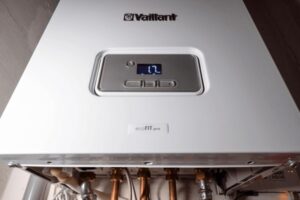

This guide explains how to fix f75 fault on Vaillant boiler and what is most likely causing it in your boiler.
There are few things more dispiriting than coming downstairs on a cold morning to find your boiler has locked out overnight and is showing an error code you have never seen before. If the display is showing F75, you are dealing with one of the more common but also more stubborn faults that affects Vaillant boilers across the UK. It tends to appear without much warning, it will not clear with a simple reset in most cases, and it often means something inside the boiler needs attention from a Gas Safe engineer.
The F75 fault on a Vaillant boiler means the unit cannot detect a change in water pressure when the pump starts up. It is usually caused by a faulty pressure sensor, a failing pump, or air and debris blocking the sensor port. In some cases it is a combination of more than one of these things. It is not a fault that goes away with a simple reset, and it typically needs a heating engineer to properly diagnose and fix.
What the F75 Fault Actually Means
To understand why the F75 appears, it helps to know what the boiler is trying to do when it fires up. Every time a Vaillant combi boiler starts, it runs a check to confirm the pump is working and water is circulating properly. It does this by monitoring pressure. When the pump kicks in, the boiler expects to see a small change in water pressure as the water starts moving through the system. If no change is detected, the boiler assumes there is a problem and locks out to protect itself, displaying the F75 code.
So the F75 is essentially the boiler saying it cannot tell whether the pump is actually doing anything. That could be because the pump genuinely is not working, because the pressure sensor that monitors this cannot read correctly, or because there is something blocking the sensor from picking up the pressure change it is looking for.
It is one of those faults that sounds more complicated than it often is, but it does need proper diagnosis rather than guesswork.
Common Causes of the F75 Fault
Faulty or blocked pressure sensor
This is the most frequently cited cause of the F75 on Vaillant boilers, particularly on models that have been in service for several years. The pressure sensor sits inside the boiler and monitors water pressure in the system. Over time, sludge, limescale, or debris can block the small port through which the sensor reads pressure, preventing it from detecting any change when the pump starts. Even if the pump is working perfectly, a blocked sensor will not register the pressure change and the boiler will lock out with F75.
In hard water areas, which covers a large portion of England, limescale is often the culprit. In older systems without a magnetic filter, sludge is frequently to blame.
Failing or seized pump
If the pump itself is struggling, running slowly, or has partially seized, it will not generate enough flow to create a measurable pressure change. A pump that is on its way out may still run but not with enough force, and the boiler will flag the F75 in response. Pumps tend to fail gradually on older boilers, though they can also go suddenly with no warning at all.
It is worth knowing that on some Vaillant models the pump is built into the boiler unit rather than being an external component, which affects how accessible it is and how a repair is carried out.
Air in the system
Trapped air in the central heating system can interfere with how pressure readings behave, particularly if there is air near the pump or sensor. This is not always the cause of an F75 but it is one of the cheaper things to rule out, and bleeding the radiators costs nothing if you do it yourself.
Low system pressure
If your boiler pressure has dropped below around 0.5 bar, the boiler may struggle to detect normal pump operation and could throw an F75 as a result. This is worth checking first before assuming a component failure, as it is one of the easiest things to sort yourself.
PCB fault
Less commonly, the printed circuit board that controls the boiler’s functions may be interpreting sensor signals incorrectly, leading to a false F75 reading. This is harder to diagnose without specialist equipment and is usually only identified after other causes have been ruled out. PCB faults are among the more expensive repairs on any gas boiler.
How to Fix f75 Fault on Vaillant Boiler: Steps You Can Take Yourself
Before picking up the phone to an engineer, there are a few things worth checking yourself. None of these require you to open the boiler or touch any gas components.
Check and repressure the boiler
Look at the pressure gauge on the front of your Vaillant boiler. It should sit between 1 and 1.5 bar when the system is cold. If it is below this, particularly below 0.8 bar, topping up the pressure may be enough to clear the fault. Find the filling loop (usually a silver braided hose beneath the boiler), open both valves slowly until the gauge reads around 1.2 bar, then close both valves and try resetting the boiler. Press and hold the reset button until the display changes, then see if the boiler fires up and runs without the fault returning.
Bleed the radiators
If the pressure is fine but you want to rule out trapped air, bleed each radiator in the house. Turn the heating off and wait for the system to cool slightly. Use a radiator bleed key on the valve at the top end of each radiator and open it slowly until water trickles out steadily. Close it, move to the next one, and work your way through the whole house. Check the pressure afterwards and top up if it has dropped, then reset the boiler.
Reset the boiler
After any of the above steps, reset the boiler and allow it to go through its startup sequence. Watch the display. If it fires and runs without returning to F75, keep an eye on it over the next day or two. If the fault comes back, it means the underlying cause has not been resolved.
That is broadly as far as you can go safely as a homeowner. If the fault returns after these steps, you need a Gas Safe engineer to take a look.
When to Call a Gas Safe Engineer
If the boiler continues to show the F75 fault after you have confirmed the pressure is correct, bled the radiators, and attempted a reset, the cause is most likely inside the boiler. You should call a Gas Safe registered engineer at that point. Do not keep resetting the boiler repeatedly hoping it will eventually clear. When a Vaillant locks out with an F75, it is protecting itself from operating without confirmed circulation, and repeatedly overriding that is not a good idea.
If you are in the middle of winter and cannot get an engineer out immediately, it is worth explaining the situation clearly when you call. Some companies will prioritise households with no heating, particularly where children or elderly residents are in the property. If you have a boiler cover plan, use it. Most plans include priority call-outs and will cover common component repairs at no additional cost.
Cost of Repairing an F75 Fault: What to Expect in the UK
The cost of fixing an F75 fault depends entirely on what is actually causing it. Here is a realistic breakdown based on current UK pricing.
Call-out and diagnosis: £60 to £120 depending on your location and the engineer. London and the South East sit at the top of this range. Most engineers will charge this regardless of what is found on the visit.
Pressure sensor replacement: This is the most common fix for the F75. The sensor itself is not a particularly expensive part, but the total cost including labour typically runs from £120 to £250. The job is usually completed in a single visit and takes around an hour or two depending on how accessible the sensor is on your particular model.
Pump replacement: If the pump is at fault, replacement costs typically range from £150 to £350 all in. On some Vaillant models the pump is more straightforward to access than on others, which affects the labour time. An experienced engineer who regularly works on Vaillant boilers will generally complete this faster than one who does not.
Clearing a blocked sensor port: If the sensor itself is fine but the port is blocked with sludge or scale, an engineer can often clear it without a full replacement. This is on the lower end of repair costs and might be included within the call-out charge, though this varies.
System powerflush: If sludge is identified as a contributing factor, a powerflush of the central heating system is often recommended at the same time as any component repair. This costs between £300 and £600 depending on system size, but it reduces the likelihood of the same or related faults reoccurring in the near future. Skipping it and just replacing parts without addressing the root cause is a false economy that many people regret.
PCB replacement: If the board is at fault, this is one of the more expensive outcomes. PCB replacement on a Vaillant boiler typically costs between £400 and £650 including parts and labour. On older boilers, this cost sometimes tips the decision toward a full boiler replacement, particularly if the unit is already twelve or more years old and other components are also showing wear.
Common Mistakes Homeowners Make
The single most common mistake with the F75 fault is resetting the boiler over and over in the hope it will eventually stay running. It will not. The boiler is locking out for a reason, and cycling through resets while the underlying fault worsens can accelerate damage to the pump or heat exchanger. One or two resets to see if the fault clears is reasonable. More than that without identifying the cause is not.
Another mistake is assuming the pressure sensor is always at fault and requesting a replacement without a proper diagnosis. While the sensor is the most common cause, fitting a new sensor into a system full of sludge or with a failing pump will not resolve the fault. A competent engineer will test the existing components before recommending replacements, not just swap parts in sequence until something works.
People also frequently overlook the connection between the F75 fault and system contamination. If your central heating has never been flushed, has no magnetic filter, and has no inhibitor in the water, there is a good chance that sludge has played a part in triggering the fault. Addressing the component without addressing the system is often a short-term fix.
Prevention Tips
Annual boiler servicing is the most effective prevention. A Gas Safe engineer carrying out a proper service will check the pump operation, inspect the pressure sensor function, and test the system pressure as a matter of course. Catching early signs of pump wear or sensor degradation before they cause a breakdown saves both money and inconvenience.
Fit a magnetic filter if you do not already have one. This catches ferrous sludge particles before they can reach and block components like the pressure sensor port. The filter itself costs around £80 to £150 fitted and can significantly extend the working life of internal boiler components.
Make sure your system water has central heating inhibitor in it. This reduces internal corrosion and slows down the formation of the sludge that causes blockages. An engineer can check the inhibitor concentration during a service and top it up if it has become too diluted over time.
If you live in a hard water area, consider a scale reducer on the boiler’s cold water inlet. Limescale buildup inside the boiler is a slow process but it can affect the pressure sensor port and the heat exchanger over several years.
Read more: F23 fault on Vaillant boiler
Understanding how to fix f75 fault on Vaillant boiler starts with not panicking and working through the simple checks first. Pressure, air, and a reset will sort the fault in a small number of cases. In most cases, though, it will need a professional to get into the boiler and test what is actually happening with the pump and sensor.
The good news is that it is generally a fixable fault at a reasonable cost, provided it is dealt with promptly and properly diagnosed rather than bodged with repeated resets or untested part replacements. And if your boiler is getting on in years and the repair bill is starting to feel steep, it is always worth asking the engineer for an honest opinion on whether a replacement makes more financial sense at this point.