
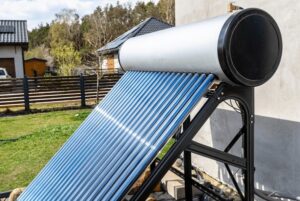

Does a solar geyser use electricity? It is probably the first question most people ask when they start looking at solar water heating as an option, and the answer is a bit more complicated than a simple yes or no. The short version is that a solar geyser is designed to run primarily on energy from the sun, but almost every system installed in a South African home also has an electrical backup element built in. So technically, yes, it can use electricity, but under normal conditions it should be using very little of it.
This matters a lot right now. Between rising electricity tariffs and ongoing load shedding, a lot of homeowners are looking at solar geysers as a way to cut costs and reduce their dependence on the grid. The problem is that some people install a solar water heating system expecting their electricity bill to drop to zero, and then feel cheated when they still see geyser-related consumption on their bill. Understanding exactly how the system works, when electricity gets used, and what you can do about it will save you a lot of frustration.
Quick answer
A solar geyser does not need electricity to heat water under normal conditions. The sun does the work. However, most systems include an electric backup element that switches on automatically when the water in the tank is not hot enough, usually after a run of cloudy days or during periods of unusually high hot water demand. How much electricity your solar geyser uses depends almost entirely on how well the system is sized and how much sun your area receives.
How a solar geyser actually works
The basic setup is straightforward. Collectors mounted on the roof, usually flat panels or evacuated glass tubes, absorb heat from the sun. That heat is transferred to water stored in an insulated tank, either directly or through a heat-transfer fluid in a closed loop system. The tank holds the hot water until you need it, and because it is well insulated, water heated during the day stays warm well into the evening.
No pump, no motor, no electricity required for any of that process. A thermosiphon system, which is the most common type installed in South African homes, works entirely on the natural principle that hot water rises and cold water sinks. The water circulates through the collectors and back into the tank without any electrical components at all.
Where electricity enters the picture is through the backup element. This is essentially a standard electric heating element inside the tank, identical to what you would find in a conventional geyser. It is connected to your home’s electrical supply and controlled by a thermostat. When the water temperature drops below a set point, the element switches on to top up the heat. In a well-functioning system with adequate sun exposure, this should not happen often. In a poorly sized or poorly installed system, it can happen almost every day.
When does the backup element actually switch on?
This is where most people get confused. The backup element in a solar geyser is there as a safety net, not as the primary heating source. It typically activates in a few situations.
After several consecutive overcast or rainy days, the collectors cannot gather enough heat to warm the full tank. The water temperature drops and the element kicks in. During winter in areas like Johannesburg or the Cape interior where nights are cold, the tank can lose significant heat overnight and the element may need to top things up in the early morning. If your household uses more hot water than the system was sized for, for example a 150L tank for a family of five, the tank empties quickly and the element runs more than it should. Some systems also have timers that force the element to run at set times regardless of water temperature, often a leftover setting from installation that nobody has adjusted.
Most people overlook that last point entirely. If your solar geyser has a timer and it is set to run the element every morning between five and seven, you are using electricity every single day even if the water was already hot from the previous afternoon. Checking and adjusting that timer is one of the simplest ways to reduce electricity consumption from a solar system.
How much electricity does it actually use?
This depends heavily on your setup, your location, and your usage habits. A well-sized solar geyser in a sunny area like Pretoria, the Northern Cape, or the Overberg can realistically cover 70 to 85 percent of a household’s water heating needs from solar alone. The remaining 15 to 30 percent comes from the backup element.
For context, a conventional 150L electric geyser typically consumes between 2,000 and 3,000 kWh per year. If a solar geyser reduces that by 75 percent, you are looking at around 500 to 750 kWh per year from the backup element. At current Eskom tariffs averaging around R2.50 to R3.00 per kWh depending on your municipality, that translates to roughly R1,200 to R2,250 per year in electricity costs for water heating, compared to R5,000 to R9,000 or more for a standard electric geyser running the same load.
In practical terms, most households with a properly installed solar geyser in South Africa see their electricity bill drop noticeably within the first few months. A rough saving of R400 to R700 per month is common for a family of four that previously relied entirely on an electric geyser.
Does a solar geyser use electricity during load shedding?
This is a question that comes up constantly, and the answer is important. The solar heating process itself is completely unaffected by load shedding. The sun still heats the water regardless of whether Eskom is on or not. The collectors keep working, the thermosiphon keeps circulating, and hot water accumulates in the tank just as it would on any other day.
The backup element, however, does not work during load shedding because it relies on grid electricity. So if you are in the middle of a stretch of cloudy days and load shedding hits at the same time, your backup element cannot run and your water may not get as hot as usual. That is genuinely inconvenient, but it is not a common scenario. On a normal sunny day you will have hot water throughout load shedding with no issues at all.
Some homeowners connect the backup element to an inverter or solar panel system so it can run off stored energy. This adds cost and complexity but does give you more consistent hot water regardless of grid availability.
Does a solar geyser use electricity more than people expect?
Honestly, sometimes yes. And it is usually not the system’s fault. The most common reason a solar geyser uses more electricity than expected comes down to three things: the system was undersized for the household, the installation was done poorly, or nobody adjusted the settings after installation.
An undersized tank is probably the most frequent culprit. A 150L system might work beautifully for two people but will struggle with four, especially if everyone showers in the morning. The tank empties, the element runs, and the savings disappear. Sizing the tank correctly for your household before you buy is one of the most important decisions in the whole process.
Poor installation can also mean the collectors are not angled correctly, are shaded for part of the day, or are not positioned to face north, which is the optimal orientation for South African homes. Even partial shading from a tree or a neighbouring building can reduce collector efficiency significantly.
Cost of a solar geyser and what affects it
The upfront cost is the main barrier for most people. A basic flat panel solar geyser system with a 150L tank, supply and installation included, typically costs between R9,000 and R14,000. A mid-range system with evacuated tube collectors and a 200L tank sits at R14,000 to R22,000. Premium systems with larger tanks, quality controllers, and full installation by experienced contractors can reach R30,000 to R40,000 or more.
Installation costs alone generally run between R2,500 and R5,000 depending on roof type, height, and whether any plumbing modifications are needed. If your roof needs reinforcement for the added weight of the tank and collectors, that can add another R2,000 to R5,000.
The payback period on a solar geyser in South Africa is typically five to eight years for a mid-range system, assuming it is properly installed and sized. After that point, your water heating costs are essentially just the small amount of electricity the backup element uses on cloudy days plus annual maintenance of around R500 to R1,000 for a check-up, panel cleaning, and pressure valve inspection.
Common mistakes homeowners make
Buying the cheapest system available is the one that tends to bite people later. Entry-level flat panel collectors often degrade faster and deliver less consistent heat than better quality evacuated tube systems, particularly in areas with variable cloud cover like the Cape coast. The saving at purchase can be eaten up by more frequent backup element use and earlier component replacement.
Not checking what warranty comes with the system is another one. Collectors should carry a warranty of at least five years, and tanks should have ten years or more. Some of the cheaper brands offer two years on the collector and that is it.
Leaving the geyser timer on its default factory settings is something almost nobody thinks about but makes a real difference to electricity consumption. Many units are set at the factory to run the element daily as a default. Adjusting this to only activate when water temperature actually drops will cut unnecessary electricity use immediately.
Is a solar geyser worth it for South African homes?
In most cases, yes, and South Africa is genuinely one of the best countries in the world for solar water heating. The solar resource here is exceptional compared to Europe or large parts of the northern hemisphere. Even in areas with more cloud cover, like the Garden Route or KwaZulu-Natal coast, a good solar geyser will still significantly outperform a conventional electric system.
The strongest case for solar is in homes where the geyser is one of the biggest electricity draws. For many households, water heating accounts for 30 to 40 percent of the total electricity bill. Cutting that down by 70 to 80 percent is a meaningful saving that compounds year after year as tariffs increase.
It is not the right choice for every situation. Renters cannot always install them, body corporate rules in complexes sometimes prevent roof modifications, and the upfront cost is a real barrier for some households. But for an owner-occupier with a suitable roof and a few years of horizon ahead of them, a properly sized solar geyser is one of the better home investments available right now.
Read more: Does solar geyser work in winter
The bottom line is that does a solar geyser use electricity, the honest answer is occasionally and much less than a conventional system. The key word is occasionally. If your solar geyser is running its backup element every day, something is off with the sizing, the installation, or the settings, and it is worth getting a qualified plumber or solar installer to check it over. A system that is working as it should will quietly heat your water through the day and barely touch your electricity bill except on the odd overcast week. That is exactly what it is supposed to do.