
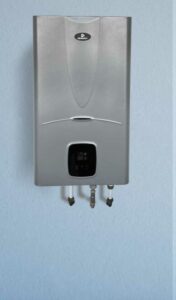

Dewhot gas geyser problems tend to follow the same pattern as most instantaneous gas water heaters: ignition failure, a unit that lights and then cuts out, inconsistent water temperature, or a complete shutdown. Some of these have straightforward causes that a homeowner can check themselves. Others need a registered gas technician. This guide walks through the full picture so you can figure out what you’re dealing with, what can be done about it, and what it’s likely to cost before you start making calls.
It usually starts with a lukewarm shower. Then a few days later the water is cold. Then the unit stops lighting altogether. If you own a Dewhot gas geyser and something has gone wrong, you’re not alone. These units are reasonably popular in South African homes, particularly among people who want an affordable gas water heating option that isn’t tied to the electricity grid. But like every gas geyser on the market, Dewhot units develop problems over time, and when they do it can be hard to know where to start.
The most common Dewhot gas geyser problems are ignition failure due to flat batteries or a dirty electrode, a flame sensor or thermocouple that’s failing and cutting the unit out shortly after it lights, low or inconsistent water temperature caused by gas pressure or flow sensor issues, and heat exchanger scaling in hard water areas. Some of these are simple checks you can do yourself. Others require a certified gas technician, particularly anything involving the gas valve or internal burner components.
Common causes of Dewhot gas geyser problems
Ignition failure: the unit won’t light
This is the most common complaint and fortunately often has the simplest cause. Dewhot gas geysers that use battery-powered electronic ignition depend on those batteries to generate the spark that lights the burner. When the batteries are low or flat, the ignition clicks weakly or doesn’t fire at all. Most people skip straight to assuming something mechanical has broken, but a fresh set of batteries resolves this more often than you’d expect.
If new batteries don’t help, look at the igniter electrode. This is a small ceramic-tipped component positioned near the burner. Carbon deposits from combustion build up on the tip over months of use and can prevent a proper spark from jumping. A visual inspection after removing the front access panel often reveals obvious sooting or discolouration. A gentle clean with a dry soft brush can restore function if deposits are the issue. A cracked or physically damaged electrode needs replacement.
The gas supply itself is also worth ruling out. A cylinder that’s run low will reduce gas pressure to the point where the burner can’t sustain ignition. Check that the cylinder valve is fully open, that the regulator is properly seated, and that there’s actually gas remaining. If you have a spare cylinder, connecting it is the easiest way to eliminate this variable.
The unit lights but shuts down almost immediately
This symptom points almost directly at the thermocouple or flame sensor. These are safety devices designed to detect whether the burner is lit. If they don’t confirm a flame within a few seconds of ignition, the gas supply is cut off as a precaution against unburned gas accumulation. It’s an important safety feature, but when the thermocouple degrades or gets misaligned, it shuts the unit down even when the burner is burning normally.
A thermocouple can fail gradually or suddenly. Gradual failure often shows up as the unit lighting reliably at first and then becoming more temperamental over weeks, needing multiple ignition attempts before staying lit. Sudden failure means the unit simply won’t stay on regardless of how many times you try. Either way, this is a component replacement job for a gas technician.
Low gas pressure from a nearly empty cylinder or an undersized regulator can produce a similar symptom. A weak flame may not register properly with the flame sensor, causing the same cut-out behaviour. Checking your gas supply before booking a technician is always worthwhile.
Water temperature is too low or fluctuates
Dewhot gas geyser problems involving temperature are usually related to one of three things: gas pressure, water pressure, or a scaling issue in the heat exchanger.
If the gas pressure is lower than the unit requires, the burner won’t reach its rated output and the water will come out warm rather than hot. Regulators can degrade over time and deliver inconsistent pressure. A regulator that’s several years old and causing this kind of symptom is worth replacing as a starting point.
Water pressure that’s outside the unit’s operating range causes erratic behaviour. Too low and the flow sensor may not trigger fully, meaning the gas valve doesn’t open to its normal position. Too high and the water moves through the heat exchanger too quickly to be heated to the set temperature. Both show up as temperature dissatisfaction. Most Dewhot units operate best between 100kPa and 600kPa water pressure. A pressure gauge on the inlet line can confirm what you’re actually working with.
Scale buildup in the heat exchanger is a longer-term issue, particularly relevant in hard water areas like parts of the Western Cape, Northern Cape, and Gauteng. Over time, calcium and magnesium deposits form a layer inside the heat exchanger that insulates the water from the heat. The burner runs but the output temperature keeps dropping. This usually builds up gradually over years rather than appearing suddenly.
The unit makes unusual noises
Some noise from a gas geyser is normal: the igniter clicking, the burner igniting with a soft thump, and the general sound of flowing water. Unusual sounds worth paying attention to include a loud bang on ignition (sometimes called a delayed ignition thump, caused by gas accumulating before the spark fires), a rumbling from the heat exchanger (associated with scale buildup or debris), or any hissing near gas connections (which should be investigated immediately as a possible leak).
Water leaks
Dripping from the inlet or outlet connections is usually a deteriorated washer or slightly loose fitting. These connections are accessible and a plumber or technician can address them quickly. Any leaking from within the unit body, particularly from around the heat exchanger, is more serious and warrants switching the unit off until it’s been inspected.
What you can safely check and do yourself
Before spending money on a callout, work through these steps:
Replace the batteries. Use good quality alkaline AA or D-cells (check your model’s requirements) and confirm they’re installed with correct polarity. This is free to try and resolves the problem more often than it should.
Check the gas supply. Confirm the cylinder valve is fully open. Check the regulator connection. If possible, test with a different cylinder. A regulator that’s more than five years old and showing any stiffness or irregularity is worth replacing anyway.
Inspect the electrode. With the unit switched off and gas closed, remove the front panel and look at the igniter electrode. If it’s visibly sooty, use a dry brush to clean it carefully. Don’t use water or cleaning solvents near this component.
Check water pressure at other taps. If pressure throughout the house seems low, the issue may be upstream. If only hot water pressure seems affected, the cold water inlet filter screen on the geyser itself may be blocked. This small mesh screen can be unscrewed from the inlet connection and rinsed clean.
Reset the unit. Switch it off, wait thirty seconds, and restart. Some Dewhot models have a reset button for thermal cutout events. If the unit tripped on overtemperature, a reset can restore normal operation.
That’s the realistic limit of what a homeowner should do without training. Everything beyond this involves gas-side components that need a registered technician.
When to call a professional
Call a registered gas technician in these situations without attempting further diagnosis yourself:
If you smell gas anywhere near the unit at any time, close the cylinder valve immediately and don’t use the unit until a technician has inspected it.
If the unit lights but consistently shuts down within seconds, the thermocouple or flame sensor needs professional testing and likely replacement.
If the burner flame is orange or yellow rather than blue, this indicates incomplete combustion and possible carbon monoxide production. This is a genuine safety hazard. Switch the unit off and get a technician out.
If any internal component is producing a noise or odour you can’t explain, don’t continue operating the unit.
If basic homeowner checks have ruled out the obvious causes and the problem persists, it’s time to book a callout rather than continuing to guess.
In South Africa, all gas appliance work must be performed by a technician registered with the Liquid Petroleum Gas Safety Association of Southern Africa (LPGSASA) or equivalent accrediting body. Repairs must be followed by a Gas Compliance Certificate for any gas-side work. This is a legal requirement and also matters for home insurance purposes.
What Dewhot gas geyser repairs cost in South Africa
These are realistic price ranges for most urban areas. Prices vary by province and technician so treat these as a guide.
Call-out and diagnosis: R450 to R900. This covers the visit and fault assessment, not parts or additional labour.
Battery replacement (if done by technician): R150 to R300 including new batteries. Worth doing yourself to avoid spending the callout fee on something this simple.
Electrode replacement: Part costs R80 to R280. Total repair including labour runs R400 to R800.
Thermocouple or flame sensor replacement: The most common Dewhot gas geyser repair. Part costs R120 to R380. Total repair with labour is R600 to R1,300.
Regulator replacement: A new LPG regulator costs R200 to R550. If the technician supplies and fits it, total cost is around R500 to R900.
Gas valve repair or replacement: Parts run R900 to R2,200 for most models. With labour, expect R1,600 to R3,500 total. At this level, the age and overall condition of the unit becomes relevant to the repair-or-replace decision.
Heat exchanger descaling: R900 to R1,600 depending on severity and time.
Heat exchanger replacement: Component costs R1,500 to R4,500 depending on the unit. Total cost including labour can reach R3,000 to R6,000. A comparison quote for a new unit is worth getting at this point.
New Dewhot unit replacement: Similar spec units start around R3,500 to R7,000 for the geyser itself, plus R2,500 to R5,000 for installation and compliance certification. If the existing unit is over eight years old and facing a major repair, replacement is often the more sensible financial decision.
Compliance certificate: R400 to R800, required after any gas-side repair.
Common mistakes people make
Assuming the problem is always mechanical when it’s often just batteries. This is worth saying again because callouts for battery failure are genuinely common. Try the batteries first, every time.
Booking a general plumber for gas work. Gas appliances require a separately registered gas installer. A plumber who isn’t gas-certified cannot legally do this work and cannot issue a compliance certificate. Some plumbers hold dual registration, but always confirm before booking.
Running the unit when it’s displaying warning signs because it seems to be working well enough. An inconsistent flame, repeated cut-outs, or a weak ignition that eventually lights are all signs that something is degrading. Leaving these issues tends to mean a more expensive repair later.
Buying replacement parts independently without confirming compatibility. Dewhot has produced various models over the years and parts aren’t always interchangeable. A technician who sources the part will verify compatibility before fitting.
Prevention tips to reduce problems over time
Service the unit every two to three years. A standard service includes cleaning the burner and electrode, testing the thermocouple and flame sensor, checking all gas and water connections, and identifying wear before it becomes a failure. Typical service cost is R600 to R1,200. It’s considerably cheaper than an emergency callout plus parts.
Replace the LPG connecting hose every five years. These hoses degrade internally before showing visible external wear. A hose failure is a gas leak, and gas leaks are not worth the risk of saving a few hundred rand.
In hard water areas, ask your technician to check the heat exchanger for scale during each service. Catching early buildup is far less expensive than a full replacement.
Keep the area around the unit clear of debris, dust, and vegetation, particularly for outdoor installations. A clean installation environment reduces burner contamination and extends service intervals.
Read more: Paloma gas geyser error codes
Most Dewhot gas geyser problems are fixable, and a good number of them are cheaper to resolve than people assume when they first notice something is wrong. Start with the basics: gas supply, batteries, electrode condition, and water pressure. If those checks don’t solve it, the thermocouple is the next most likely culprit and it’s not an expensive repair.
Where costs escalate is with gas valve and heat exchanger issues, and at that point the decision shifts to whether repair or replacement makes more financial sense given the unit’s age. Whatever route you take, make sure the work is done by a registered gas technician and that you get a compliance certificate at the end of it. Your safety and your insurance cover both depend on it.