
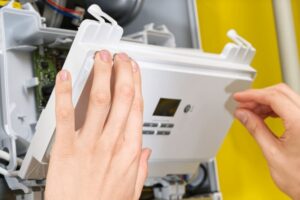

There are few things more baffling for a homeowner than walking past the boiler cupboard and hearing it firing away at midnight, knowing full well you’ve set the programmer to switch everything off hours ago. If your boiler keeps running when programmer is off, you are not imagining things and you are certainly not alone. It is one of those problems that tends to sneak up on people, often during the colder months when the central heating system is working hardest. The good news is that there are a handful of well-known causes, and several of them you can sort yourself without spending a penny.
Quick answer
When a boiler continues to run despite the programmer being set to off, the most common culprits are a faulty or misconfigured thermostat, a stuck diverter valve, a wiring fault, or a programmer that has lost its settings. In some cases, the boiler is actually doing what it is supposed to do but a component somewhere in the system is not passing the signal on correctly. Start with the simple checks before assuming the worst.
Why does this happen? The most common causes
The programmer has lost its settings or schedule
This one catches people out more often than you might expect. Programmers, particularly older mechanical ones, can lose their time settings after a power cut or a flat backup battery. If the clock has reset to midnight or the programme has been wiped, the boiler may be running at completely the wrong times. Digital programmers can also develop faults where they simply stop sending the off signal even though the display looks fine.
Check the actual time showing on your programmer and compare it to the real time. If they do not match, that is almost certainly your problem. Reprogramming it should fix things immediately.
A faulty room thermostat
Room thermostats tell the boiler when the house has reached the target temperature and it is safe to stop. If the thermostat is broken, stuck, or positioned somewhere draughty (like near an outside door), it may never register that the room is warm enough. As a result, the boiler just keeps firing.
Most people overlook this entirely and go straight to blaming the boiler itself. Try turning the thermostat dial right down to its lowest setting. If the boiler shuts off, the thermostat is likely reading the temperature incorrectly. It could also just need recalibrating, which an engineer can do quickly.
A stuck or faulty diverter valve
Combi boilers and some system boilers use a diverter valve to direct hot water either to the radiators or to the hot water tap, depending on what you need at that moment. When this valve sticks, it can cause the boiler to run continuously or behave in unexpected ways, such as producing hot water when only heating was requested, or vice versa.
A diverter valve replacement typically costs between £150 and £350 including labour, depending on the boiler model and how accessible the valve is. It is not a DIY job because it involves working inside the boiler itself.
Wiring issues between the programmer and boiler
The programmer communicates with the boiler through a fairly simple set of wires. If those connections corrode, come loose, or short together, the boiler can receive a permanent “on” signal even when the programmer is telling it to stop. This is not ideal, and it is also not immediately obvious unless someone physically inspects the wiring.
If your programmer is more than ten years old and has never been checked, this is worth raising with an engineer. A wiring inspection during a standard boiler service call usually takes no more than thirty minutes.
The boiler is in “frost protection” mode
Many modern gas boilers have a built-in frost protection function that overrides the programmer when temperatures drop close to freezing. The boiler fires periodically to stop pipes from freezing, even if you have set it to off. This is actually the boiler doing exactly what it should do, and it is worth knowing about if you live somewhere that gets cold winters.
You can usually identify this as the cause if the boiler only fires briefly and then shuts off again after a short time, rather than running continuously. It tends to happen in early morning or late at night when outdoor temperatures are lowest.
Faulty boiler control board or PCB
The PCB (printed circuit board) is essentially the brain of the boiler. A fault here can cause all sorts of erratic behaviour, including the boiler running when it has no reason to. PCB faults are more common in older boilers and those that have suffered water ingress or power surges.
Replacing a PCB is one of the more expensive boiler repairs. You are typically looking at £200 to £500 or more depending on the boiler make, with older or discontinued models sometimes costing even more because the parts are harder to source.
How to fix it: steps to try yourself
Step 1: Check and reset the programmer Start here. Verify the time is correct and that the on/off schedules are set the way you want them. If in doubt, do a full factory reset and re-enter your preferred schedule from scratch. The manual for most programmers is available online even if you have lost the paper copy.
Step 2: Turn the room thermostat right down Set it to its minimum temperature. If the boiler shuts off, the issue is likely with how the thermostat is reading the room temperature, not with the boiler itself. Try repositioning the thermostat if it is near a heat source or a draughty area.
Step 3: Check whether it might be frost protection If it is cold outside and the boiler is only running in short bursts, check your boiler manual to see if frost protection is active. This is usually a setting you can adjust, though most engineers would advise leaving it on during winter.
Step 4: Listen and observe Is the boiler running silently in the background, or is it making any unusual noises? Is it producing heat at the radiators, or is it just running without heating anything? These details help pinpoint whether the issue is a diverter valve, a thermostat, or something else entirely.
Step 5: Switch the boiler off at the programmer and at the boiler itself If the boiler continues to run even when you have switched it off at both points, there is almost certainly an electrical or wiring fault. At that point, you should contact a Gas Safe registered engineer rather than investigating further yourself.
When to call a Gas Safe engineer
Some of these faults are genuinely dangerous to investigate without the right qualifications. You should call an engineer if:
The boiler runs continuously and cannot be switched off using the programmer or the boiler controls. There is any smell of gas near the boiler at any time. The boiler is making banging, kettling, or gurgling sounds alongside the unexpected running. You have already tried the simple checks above and the problem persists.
In the UK, any work on gas appliances must legally be carried out by a Gas Safe registered engineer. Always ask to see their Gas Safe ID before work begins. You can verify any engineer’s credentials at the Gas Safe Register website.
What repairs are likely to cost in the UK
Here is a rough guide to what you might pay depending on the cause. These are ballpark figures and prices vary by region, with London and the South East typically running higher.
Programmer replacement: £80 to £200 including fitting. Smart thermostats and programmers sit at the higher end but can save on energy bills over time.
Room thermostat replacement: £70 to £180 fitted. Wireless thermostats are a bit more but are far easier to position correctly.
Diverter valve replacement: £150 to £350 fitted. Parts for older boilers can push this higher.
Wiring investigation and repair: £60 to £150 for an engineer call-out and inspection, with additional costs if wiring needs replacing.
PCB replacement: £200 to £500 or more. On older boilers, the cost of a PCB can sometimes tip the decision toward full boiler replacement instead.
Full boiler replacement: If the boiler is more than twelve to fifteen years old and the repair bill is heading toward the £400 to £500 mark, replacement is worth serious consideration. A new combi boiler installation typically costs between £1,800 and £3,500 depending on the boiler model, flue position, and any pipework changes needed.
Common mistakes homeowners make
The most common mistake is assuming the problem is with the boiler when it is actually the programmer or thermostat. These are far cheaper to fix and are frequently overlooked. A lot of people call out a heating engineer expecting to be told the boiler needs replacing, only to find the programmer needed a new battery and a reset.
Another mistake is ignoring the problem because the heating seems to be working fine otherwise. A boiler running when it should not be is wasting gas and money, and it is also putting unnecessary wear on the system. Over a winter, that kind of inefficiency can add meaningfully to your gas bill.
Finally, some people attempt to bypass wiring or adjust internal boiler components themselves. That is not worth the risk, both from a safety standpoint and because it can void any remaining warranty on the boiler.
Prevention tips worth knowing
Get the boiler serviced annually. A good engineer will catch wiring issues, valve wear, and thermostat drift before they become bigger problems. An annual service typically costs between £60 and £120, which is modest compared to what a missed fault can end up costing.
If your programmer is more than ten years old, consider upgrading to a smart thermostat system. Nest, Hive, and similar systems are easier to manage and generally more reliable than older mechanical or basic digital programmers. They also give you remote access via your phone, so you can see exactly what the boiler is doing at any time.
Bleed your radiators at the start of each heating season. Air in the system can cause pressure fluctuations that confuse the boiler and lead to irregular behaviour. It takes about ten minutes and costs nothing.
Read more: Can you use toilet when boiler is being replaced
A boiler keeps running when programmer is off is the kind of fault that is easy to dismiss at first, but it is worth taking seriously. In most cases, the fix is straightforward and does not require a major repair. Start with the programmer settings and thermostat before escalating to an engineer. If you do need professional help, make sure you use someone Gas Safe registered and get at least two quotes for anything over £200.
And if your boiler is getting on in years, use this as an opportunity to have an honest conversation about whether a replacement might actually save you money in the long run. Sometimes the most practical fix is also the most expensive one upfront.