

If you’ve been trying to find the best gas geyser in South Africa, you’ve probably already discovered that there are a lot of options and not a lot of clear guidance on how to actually compare them. Reviews online tend to either be vague or push specific products without explaining the reasoning. The truth is that the “best” gas geyser is genuinely different depending on your household size, your gas setup, your water pressure, and how much you’re willing to spend upfront versus over time.
What most people actually need isn’t a single product recommendation. They need to understand which features matter for their specific situation and which ones are just marketing. This guide is aimed at helping South African homeowners make a genuinely informed decision, covering the things that actually separate a good gas water heater from one that’s going to frustrate you within a year. Load shedding has pushed a lot of households to look at gas for the first time, and getting this decision right matters more than it used to.
Quick answer
The right gas geyser for your home comes down to five things: flow rate matched to your household demand, a brand with local parts availability and service support, a unit rated for your gas type (LPG or natural gas), a build quality that will last more than a few years, and a total cost (unit plus installation) that fits your budget. No single brand is the right answer for every home.
What a gas geyser actually does and what to expect
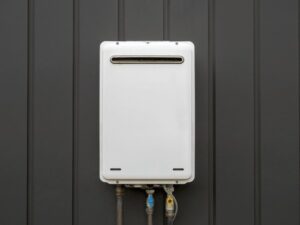
An instantaneous gas geyser heats water on demand by running cold water through a heat exchanger while a gas burner fires underneath it. There’s no storage tank, which means you don’t run out of hot water the way you might with a 100-litre electric geyser. As long as the gas cylinder has fuel and the water is flowing, the unit heats continuously.
The tradeoff is that performance is directly tied to gas pressure, water pressure, and the unit’s rated output. A unit that’s too small for your household’s demand will struggle to keep water hot when multiple taps are running simultaneously. A unit that’s too large is money spent unnecessarily. Getting the sizing right is arguably more important than which brand you choose.
For South African homes dealing with load shedding, the appeal is obvious. A gas geyser operates entirely independently of the electricity grid, which means hot water regardless of what Eskom is doing. That independence is worth a lot, and it’s driving a lot of people to look at gas water heating for the first time.
Types and options available in South Africa
Instantaneous LPG gas geysers
These are the most common type in South African homes and what most people mean when they search for a gas geyser. They run on LPG (liquefied petroleum gas) from cylinders, typically 9kg, 19kg, or 48kg. They’re available from a range of local and imported brands, cover a wide range of flow rates, and are the most straightforward to install in homes without existing gas infrastructure.
Natural gas units
In areas with piped natural gas availability, such as parts of Johannesburg’s northern suburbs and certain other urban areas, natural gas units offer the convenience of not dealing with cylinders at all. These units are not interchangeable with LPG units without a conversion kit, so confirm your gas type before purchasing.
Dual-gas models
Some units come configured for either LPG or natural gas with an included conversion kit or a simple adjustment. These offer flexibility if your gas supply situation might change.
Indoor vs outdoor models
Outdoor units are the simplest option for most homes: no ventilation requirements, simpler installation, and generally cheaper to fit. Indoor units are available for situations where outdoor installation isn’t practical, but they require proper ventilation in compliance with SANS 10087-1 and add complexity and cost to the installation.
Premium models with digital control and fault diagnostics
Higher-end units include digital temperature displays, remote controls, modulating gas valves that adjust output based on demand, and built-in fault code systems. These are genuinely useful features rather than just extras. Modulating gas valves in particular deliver more consistent water temperature than simpler on/off valve designs.
Cost breakdown: what you’ll actually spend
This is where a lot of people get caught out because the unit price and the total cost are very different numbers.
Unit cost by flow rate:
A small 6L to 10L/min unit for a flat or single bathroom runs R2,800 to R5,000. A mid-range 12L to 16L/min unit suited to most two to three bathroom homes costs R5,000 to R9,000. A high-output 20L/min and above unit for larger homes or high demand situations runs R9,000 to R16,000 or more.
Installation cost:
A basic installation where gas infrastructure is already in place can cost as little as R2,000 to R3,000 in labour. A new installation from scratch, including running gas piping from the cylinder point to the geyser location, typically runs R3,500 to R6,000. Complex installs involving long pipe runs, indoor ventilation requirements, or significant plumbing changes can push R6,000 to R9,000.
Additional costs people often miss:
The Gas Compliance Certificate, which is legally required after any gas installation in South Africa, adds R400 to R800. A new regulator if yours is old or undersized costs R250 to R600. Cylinder cage or mounting hardware adds a few hundred rand. If your cylinder needs to be upsized to match a higher-flow unit, a 48kg cylinder costs R1,500 to R2,200 to fill versus R280 to R380 for a 9kg.
Total all-in estimates:
| Household scenario | Estimated total cost | |
| Small flat, 10L/min unit, basic install | R7,000 to R11,000 | |
| Average home, 16L/min, new gas line needed | R11,000 to R17,000 | |
| Larger home, 20L/min, full conversion from electric | R15,000 to R24,000+ |
These ranges reflect typical metro pricing. Rural areas may differ based on installer availability.
What actually separates a good unit from a poor one
Flow rate matched to demand
This is the single most important factor when choosing the best gas geyser in South Africa for your home, and it’s the most commonly gotten wrong. Flow rate is measured in litres per minute and tells you how much hot water the unit can deliver continuously. A standard shower head runs at about 8 to 10 litres per minute. A rain shower head can hit 15 or more. If your unit’s flow rate barely covers one shower at full temperature, you’re going to have problems the moment someone else opens a tap.
Calculate your simultaneous demand realistically: how many outlets might run hot water at the same time in your home during a busy morning? That number guides the minimum flow rate you need.
Local parts availability and service support
This is something a lot of buyers overlook when comparing unit prices. A cheaper imported gas geyser that saves you R2,000 upfront can cost far more if it breaks down and the local importer doesn’t stock spare parts. Thermocouples, gas valves, and electrodes need to be available locally through a technician or distributor. Before purchasing, it’s worth asking your installer which brands they’ve had good parts availability experience with in your area.
Build quality and expected lifespan
A well-maintained gas geyser should last eight to fifteen years. Budget units at the lower end of the market can fail within three to five years, particularly internal components like the gas valve and heat exchanger. The cost of an early repair or replacement eats into any initial saving quickly.
Water pressure compatibility
Every gas geyser has a minimum and maximum water pressure operating range. Most South African residential connections sit between 150kPa and 500kPa, but this varies. If your pressure is at the lower end, you need a unit with a low minimum activation pressure, otherwise the flow sensor won’t trigger the gas valve and the unit won’t fire. Ask your installer to check your pressure before specifying the unit.
Modulating vs non-modulating gas valve
A modulating gas valve adjusts the flame size based on the flow rate of water, which means more consistent outlet temperature as demand changes. Non-modulating valves operate at fixed high or low settings, which can result in temperature swings when flow rate changes. For primary hot water use, a modulating valve is worth the additional cost.
How the buying and installation process works
Once you’ve settled on the right flow rate and unit type for your situation, the process runs roughly like this:
Get a site assessment from a registered gas installer before purchasing the unit. A good installer will check your water pressure, assess the ideal mounting location, determine the gas pipe run required, and advise on cylinder sizing. This assessment is usually free or low-cost and can prevent expensive surprises.
Source the unit and confirm compatibility with your installer. If possible, let your installer source or at least approve the unit before purchase to confirm it’s the right fit for your site conditions and that they can support it with parts if needed.
Confirm the installer is LPGSASA-registered and will provide a Gas Compliance Certificate on completion. This is not optional in South Africa, and any installer who says it isn’t necessary is not someone you want working on your gas installation.
Allow half a day to a full day for the installation depending on complexity. Simple installations can be done in three hours. New gas line installations with more complex plumbing take longer.
After installation, test the unit thoroughly before the installer leaves: check temperature at different flow rates, confirm ignition reliability, and ensure all connections have been pressure-tested for leaks.
Common mistakes buyers make
Buying the unit before consulting an installer is probably the most common and most expensive mistake. People find a deal online, purchase the unit, and then discover their water pressure is too low for that model, or the installation will cost significantly more than expected because of site constraints. Talk to an installer first.
Choosing a unit based on price alone without considering total cost of ownership. A R3,500 unit that needs a major repair in three years and has no readily available parts ends up being more expensive than a R6,500 unit that runs reliably for twelve years. The upfront price is only part of the picture.
Undersizing the flow rate. This comes up repeatedly because it’s so common. It’s worth slightly oversizing rather than undersizing, because a unit that’s a bit more capable than you strictly need will operate less hard and last longer.
Skipping the site assessment and asking the installer to just “fit whatever works.” Without a proper assessment, you risk ending up with the wrong unit, an avoidable installation complication, or a setup that doesn’t perform as expected.
How to choose properly for your home
A few questions that help narrow down the right choice:
How many people live in your home and how many bathrooms do you have? A single person in a one-bathroom flat has very different needs from a family of five in a four-bedroom house. This drives flow rate selection more than anything else.
Is this replacing an existing gas water heater or converting from electric? A like-for-like gas replacement is simpler and cheaper. A conversion from electric involves more gas piping work and potentially plumbing adjustments.
Do you have LPG cylinders or access to piped natural gas? Confirm before purchasing, because the units are not interchangeable without modification.
What is your water pressure? Low-pressure properties need a unit with a low minimum activation pressure. Your installer can measure this.
Is your installation indoor or outdoor? Outdoor is simpler. Indoor requires ventilation compliance and often costs more to install.
What’s your total budget including installation? Work backwards from a realistic total budget to find the right unit price range, rather than buying a unit and then discovering the installation pushes you over budget.
Read more: Can a gas geyser burst
Finding the best gas geyser in South Africa for your specific home is less about picking a brand name and more about matching a unit’s specifications to your household’s actual needs. Flow rate, gas type compatibility, water pressure operating range, parts availability, and build quality are what separate a unit that works well for years from one that disappoints within months.
Get a site assessment from a registered installer before buying anything, be realistic about simultaneous hot water demand in your home, and factor installation and compliance costs into your total budget from the start. Do those things and you’re in a strong position to make a choice you won’t regret.