
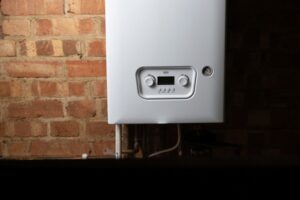

If you’ve just moved into a new place or you’re trying to get your head around a boiler upgrade, questions about what equipment you actually need are completely reasonable. One of the most common ones that comes up is do combi boilers have a water tank, and it’s a fair thing to wonder about, especially if you’ve lived in a house with a big cylinder in the airing cupboard or a tank rattling away in the loft.
The honest answer is no, a combi boiler doesn’t need a separate water tank, and that’s actually one of the main reasons they’ve become so popular in UK homes over the past couple of decades. But there’s a bit more to it than that, and understanding how the system actually works helps you make better decisions about your heating and hot water setup. This guide covers everything from how a combi works without a tank, to when a tank might actually still make sense for your home.
The quick answer
A combi boiler does not have a separate cold water storage tank or a hot water cylinder. It heats water directly from the mains on demand, whenever you turn on a tap or the heating. Everything happens inside the single unit, which is why they’re called combination boilers. This makes them more compact than older heating systems, but it also comes with some limitations depending on your household’s hot water usage.
What’s actually inside a combi boiler
This is where a lot of people get a bit confused, and understandably so. A combi boiler does contain a small internal expansion vessel, which manages pressure changes in the system as water heats up and expands. Some people mistake this for a water tank, but it’s not storing usable water in the traditional sense. It’s simply a sealed chamber with a rubber diaphragm that absorbs pressure fluctuations. You can’t draw hot water from it, and it has nothing to do with your hot water supply.
What a combi boiler actually does is take cold water directly from the mains supply and pass it through a heat exchanger inside the unit. When you open a hot tap, the boiler fires up, heats the water as it flows through, and delivers it to your tap. When you want heating, the same unit heats water and circulates it through a closed loop around your radiators. That’s the combination part: two functions, one box, no tanks.
Most people are surprised when an engineer opens up the cupboard and there’s just the boiler sitting there. No cylinder, no tank upstairs. It feels like something should be missing, but nothing is.
How this compares to systems that do use tanks
To really understand why a combi doesn’t need a tank, it helps to look at the systems that do.
Conventional (regular) boilers are the older setup you’ll find in a lot of houses built before the 1990s. These work with two separate tanks: a cold water storage cistern in the loft that feeds the system under gravity, and a hot water cylinder (often in the airing cupboard) where hot water is stored and kept warm until you need it. It’s a perfectly functional system, but it uses a lot of space and involves more components that can fail over time.
System boilers are a middle ground. They don’t need the cold water tank in the loft because they draw directly from the mains, but they still use a hot water cylinder. The cylinder stores a volume of pre-heated water so you can run multiple taps or showers without the pressure dropping. They’re a common choice in larger homes with higher hot water demand.
Combi boilers do away with both the cylinder and the cold water tank entirely. Everything runs on mains pressure, and water is heated on demand rather than stored. The trade-off is that the flow rate and temperature are limited by what the boiler can heat in real time, which can become an issue if multiple outlets are being used at once.
Why no tank is usually a good thing
For a significant portion of UK homes, particularly smaller terraced houses, flats, and two-bedroom properties, not having a tank is genuinely advantageous. Here’s why.
Space is the obvious one. Removing the cylinder and loft tank frees up the airing cupboard entirely and clears the loft of a unit that can cause all sorts of problems if the ball valve sticks or the tank develops a slow leak. Anyone who’s dealt with a loft tank overflowing in the night will appreciate this particular benefit quite a lot.
Efficiency is another factor. With a traditional stored system, water is heated and then kept warm in the cylinder, which means heat is constantly escaping even when you don’t need hot water. You’re essentially paying to maintain the temperature of water you haven’t used yet. A combi only heats water when you actually ask for it, so there’s no standby heat loss.
Installation is also simpler when you’re doing a like-for-like combi replacement, which helps keep costs down. An engineer fitting a new combi where an old combi used to sit can usually complete the job in a single day, and labour costs reflect that. Compare that to a conversion from a conventional system, which can take two days or more and involves removing the cylinder, capping pipework, and potentially making good the airing cupboard and loft space.
When you might actually still want a tank
Here’s the thing about combi boilers: they work brilliantly for some households and less well for others. Knowing the difference matters.
If your home has more than one bathroom and people tend to use them at the same time, a combi boiler can struggle. Hot water on a combi is limited by flow rate, which is essentially how quickly the boiler can heat water passing through it. Running two showers simultaneously often means reduced pressure, fluctuating temperature, or one of them simply going cold. That’s not ideal, and it’s a genuine limitation of the technology.
In those situations, a system boiler with a hot water cylinder makes more practical sense. The cylinder stores a decent volume of hot water (typically 150 to 300 litres depending on the size) so multiple outlets can draw from it without fighting over the boiler’s output. The trade-off is that you need the space for a cylinder and the water can run out if demand is exceptionally high, though a well-sized system should handle most families comfortably.
Mains water pressure is another consideration. Do combi boilers have a water tank to compensate for low mains pressure? No, they don’t, and this is actually a limitation worth checking before installation. A combi boiler relies on good mains pressure to deliver a satisfying hot water flow. If your mains pressure is low (which affects some older properties and certain areas), the hot water performance from a combi can be disappointing. An engineer can check your mains pressure before recommending a boiler type.
What happens when you switch from a tank system to a combi
This comes up a lot when people are replacing an older boiler in a house that previously had a conventional system with a tank in the loft. Converting to a combi is absolutely possible in most cases, but there are a few things to understand about what the process involves.
The engineer will need to remove the cold water storage cistern from the loft, cap off the pipework that fed it, and decommission or remove the hot water cylinder. The existing radiator pipework can usually stay in place. The boiler is then connected directly to the mains supply, and the system is balanced and tested.
This type of conversion typically takes one to two days rather than the single day a straight combi swap takes. Expect to pay more for the labour as a result. A full conventional-to-combi conversion, including the new boiler, removal of old equipment, and installation work, often comes to between £2,500 and £4,500 depending on the complexity, the boiler chosen, and your location in the UK. London and the South East tend to be at the higher end of that range.
One practical tip that a lot of people overlook: if your airing cupboard previously housed the hot water cylinder, you’ll have a newly empty cupboard once it’s removed. Some homeowners don’t plan for this and end up with an awkward space that needs shelving or a door modification. It’s a minor thing, but worth thinking about.
A note on water quality and hard water areas
One issue that affects combi boilers specifically, and links back to the tank question, is limescale. Because a combi heats water directly from the mains and that water passes through the heat exchanger every time you use hot water, hard water areas cause scale to build up inside the boiler over time. With a cylinder-based system, scale is more of a problem in the cylinder itself and can be managed more easily.
In hard water areas (much of the South East, Midlands, and parts of the North), fitting a scale reducer or inline filter is genuinely worth doing when the boiler is installed. It protects the heat exchanger and extends the boiler’s working life. The cost is relatively modest, usually £100 to £200 fitted, and the benefit in a hard water area is real. Most engineers should mention this, but not all of them do.
Common mistakes people make when thinking about combi boilers and tanks
Assuming every home should have a combi is probably the most common one. The no-tank setup sounds appealing and it’s well marketed, but it genuinely isn’t the right answer for every property. A large family home with two or three bathrooms often does better with a system boiler. Choosing a combi purely because it sounds simpler, without considering the household’s actual demand, is where people end up disappointed with their hot water performance.
Another mistake is not checking what happens to the old tank and cylinder before the work starts. Some homeowners assume the engineer will handle everything and are then surprised to find that tank removal, disposal, and making good the space adds to the total bill. Get a clear quote upfront that specifies whether the old equipment removal is included.
Skipping the annual service after installation is also a mistake. A combi boiler should be serviced every twelve months by a Gas Safe engineer. This costs around £80 to £120 and keeps the boiler working efficiently, protects any remaining manufacturer warranty, and catches small issues before they become expensive repairs.
What does all this cost in practical terms
Just to summarise the rough figures in one place:
New combi boiler with straightforward installation (like-for-like replacement): £1,500 to £2,800 all in. Conventional system to combi conversion (removal of tank and cylinder, new boiler and installation): £2,500 to £4,500. System boiler with new cylinder (for larger households): £2,000 to £4,000 depending on cylinder size and boiler output. Annual service to keep things running properly: £80 to £120. Scale reducer fitted at installation in a hard water area: £100 to £200.
These are realistic UK figures based on typical market rates, but always get at least two or three quotes from Gas Safe registered engineers before committing to any significant work.
Read more: Is a Combi boiler cheaper to run
So, do combi boilers have a water tank? No, and for most smaller UK homes that’s genuinely a benefit. Less equipment, less to go wrong, less space taken up, and lower running costs from not keeping stored water hot. But the right choice depends on your household’s size, hot water demand, mains pressure, and how your existing system is set up. Understanding how the technology actually works, rather than just going with whatever an engineer suggests without question, puts you in a much better position to get a heating system that genuinely suits your home for the next ten to fifteen years.