

Most people never think about their water heater until something goes wrong. Either the shower runs cold halfway through, or they get a surprise on their energy bill and start wondering where all that money went. One of the simplest things you can do, and one that most homeowners genuinely overlook, is check and adjust the temperature on your water heater. It sounds minor, but getting this wrong can actually affect your health, your safety, and your monthly costs more than you might expect. So if you have been wondering what temp should hot water heater be, this guide walks you through everything you need to know in plain, practical terms.
The quick answer
For most homes, the U.S. Department of Energy recommends setting your water heater to 120 degrees Fahrenheit (49 degrees Celsius). This is warm enough to handle everyday tasks like showering, washing dishes, and doing laundry, while being low enough to reduce energy use and minimize the risk of scalding. Some situations call for a higher setting, which we will cover below, but 120°F is the safe starting point for the majority of households.
Why the temperature setting actually matters
This is not just a comfort thing. The temperature on your water heating system has real consequences.
Scalding risk: Water at 140°F can cause serious burns in as little as five seconds. Children and elderly people are especially vulnerable because their skin is more sensitive. Lowering the temperature to 120°F gives you a larger margin of safety, particularly in homes with young kids.
Bacterial growth: Here is the flip side. If your water heater is set too low, below around 120°F, you create a warm environment that can allow bacteria like Legionella to grow inside the tank. Legionella is the bacteria responsible for Legionnaires’ disease, a serious form of pneumonia. This is not a scare tactic, it is a real concern that health organizations have documented in poorly maintained water systems.
Energy costs: Every 10°F reduction in water heater temperature saves roughly 3 to 5 percent on your water heating bill. Given that water heating accounts for about 14 to 18 percent of a typical household’s energy costs, keeping your tank at 120°F rather than 140°F can add up to noticeable savings over the course of a year.
What happens when the setting is too high
A lot of older homes still have their tank water heaters set to 140°F from the factory default. Manufacturers often ship units at this higher temperature, partly to account for heat loss in long pipe runs, and partly because it has just been the traditional setting for decades. But for most residential situations, 140°F is higher than you actually need.
Running your hot water system at 140°F continuously costs more, puts extra stress on the tank and its components, and increases the chance of someone getting scalded. It also accelerates mineral buildup inside the tank, especially in areas with hard water. That sediment reduces efficiency over time and can shorten the life of your unit. It is not ideal, and it is an easy fix.
What happens when the setting is too low
On the other end, setting your water heater below 120°F is also a problem. Some people dial it down thinking they will save money, and while there is a small energy benefit, the bacterial risk outweighs it. The 120°F threshold is specifically designed to kill harmful bacteria while keeping the water safe to touch.
If you have been dealing with lukewarm water and suspect the thermostat is set too low, that is usually where things go wrong. A simple thermostat adjustment is often all it takes to bring things back to normal.
When 140°F is actually the right choice
There are a few specific situations where a higher temperature setting makes sense.
Dishwashers without a booster heater: Some older dishwashers do not have their own internal heating element to boost water temperature. In those cases, the water needs to arrive hot enough to sanitize dishes properly, and 120°F may not cut it. If your dishwasher manual recommends higher inlet temperatures, setting the tank to 140°F might be necessary. Newer dishwashers typically handle this on their own.
Households with immune-compromised individuals: If someone in your home has a weakened immune system, a doctor may specifically recommend keeping the water at 140°F to reduce the Legionella risk, even though hotter water carries its own burn risk. In this case, installing anti-scald mixing valves at faucets and showers is a smart way to have both safety and sanitation.
Large homes with long pipe runs: In very large houses where hot water travels a long distance from the tank to the tap, some heat loss occurs in transit. Slightly higher thermostat settings can compensate for this, though a better long-term solution is often a recirculating pump.
How to check and adjust your water heater temperature
This is actually simpler than most people expect.
For a tank water heater: Gas units typically have a dial on the gas valve, usually on the front of the unit near the bottom. It may show settings like “Hot,” “A,” “B,” “C,” or an actual temperature scale. Electric units often have two thermostats, one for the upper heating element and one for the lower, hidden behind access panels on the side of the tank. You will need a flathead screwdriver to remove the panels and adjust the thermostats. Always turn off the power at the breaker before touching anything inside those panels.
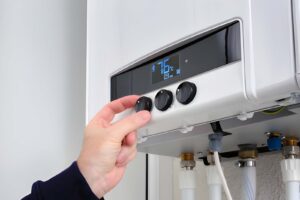
For a tankless water heater: Most modern tankless units have a digital display and control panel that makes adjustment straightforward. You can usually just press a button to cycle through temperature settings. If yours does not have a display, refer to the manual for the dial or dip switch configuration.
To verify the actual output temperature: Run the hot water at a tap for a couple of minutes to flush out any cooled water sitting in the pipes. Then fill a glass and use a kitchen thermometer or a simple candy thermometer to check the temperature. If it reads between 118°F and 122°F, you are in good shape.
Common mistakes homeowners make
The most common mistake is simply never adjusting the thermostat at all after installation. A lot of homeowners just assume the factory setting is correct and leave it there for years. Sometimes it is fine, but often the unit was shipped at 140°F and no one ever checked.
Another mistake is lowering the temperature to save energy without understanding the bacterial risk. The 120°F floor is there for a reason, and going below it, even slightly, is not worth the trade-off.
Some people also adjust the thermostat on an electric water heater without turning off the circuit breaker first. That is a safety issue. Electric water heaters run on 240-volt circuits, which can seriously injure you if you are not careful.
The cost side of things
If your water heater thermostat has drifted or was factory-set too high, adjusting it down to 120°F can save you anywhere from $15 to $60 per year depending on your local energy rates and how much hot water your household uses. That is not a life-changing number, but it is also essentially free money for about ten minutes of work.
If you discover your thermostat is faulty and not actually maintaining the set temperature, replacing a thermostat on an electric water heater typically costs between $20 and $50 for the part, plus $75 to $150 in labor if you hire a plumber. On a gas unit, thermostat issues often involve the gas valve assembly, which can run $150 to $300 or more for parts and labor combined. These are ballpark figures and can vary quite a bit depending on your location and the specific unit.
If the unit is older than 10 to 12 years and the thermostat has started failing, it may be worth considering a full replacement rather than a repair. A new tank water heater typically costs $400 to $900 for the unit, plus $200 to $500 for installation. A tankless unit runs higher, usually $800 to $1,500 for the unit and $500 to $1,000 for installation, but the long-term efficiency gains can offset that over several years.
Practical tips most people miss
One thing worth knowing is that if you are going on vacation for a week or more, many water heaters have a “vacation mode” or low setting specifically for that situation. Dropping the temperature while you are away saves energy without allowing the tank to go completely cold, which reduces the bacterial risk and keeps things from feeling stale when you return.
Also, if you have a two-thermostat electric unit, make sure both the upper and lower thermostats are set to the same temperature. Mismatched settings are a surprisingly common cause of inconsistent water temperatures, where the first few gallons are scalding and the rest is lukewarm. Most people assume the unit is failing when really the thermostats just need to be synchronized.
When to call a professional
You should call a licensed plumber or HVAC technician if:
- Your water heater is not reaching the set temperature even after adjusting the thermostat
- You hear rumbling or popping noises coming from the tank, which usually means significant sediment buildup
- You notice rust-colored water or a rotten egg smell, which can indicate corrosion or bacterial issues
- The temperature fluctuates wildly and inconsistently
- You are uncomfortable working near gas lines or 240-volt electrical systems
Some of these issues are simple fixes in terms of what temp should hot water heater be, but others signal that the unit is nearing the end of its life. A professional can assess whether a repair makes sense or whether replacement is the smarter financial decision.
Read more: How do you turn a water heater on
Setting your water heater temperature is one of those small maintenance tasks that takes very little effort but can make a real difference in your household’s safety, comfort, and energy costs. The sweet spot for most homes is 120°F, and if you have not checked yours recently, it is worth taking ten minutes to verify. If your unit is set significantly higher, simply dialing it back could save you money every single month without any noticeable change in your daily hot water experience.
And if something does not seem right after you adjust it, that is your signal to have a professional take a closer look before a small issue turns into an expensive repair.