
A solar water geyser is one of those home upgrades that South Africans have been slowly warming up to for years, but the combination of Eskom’s relentless tariff increases and the ongoing reality of load shedding has pushed it from a fringe decision to a mainstream one. Heating water is expensive. For most households, it accounts for somewhere between 30% and 50% of the total monthly electricity bill. That’s a significant slice of money going to Eskom every single month, and it’s money that a well-sized and properly installed solar system can largely recover over time.
What’s surprising is how many people still aren’t entirely sure what a solar water geyser actually is, how it differs from a standard electric geyser, or whether it will realistically work for their home. The technology is well-established and South Africa’s climate is genuinely well-suited to it, but there are real decisions to make about system type, sizing, installation, and budget. Get those right and the long-term benefits are solid. Get them wrong and you’re left with an expensive system that underperforms and a plumber’s number you call more often than you’d like. This guide covers all of it.
A solar water geyser uses energy from sunlight to heat water instead of relying on an electric element powered by the grid. In South Africa, a complete installed system typically costs between R12,000 and R40,000 depending on the system type and household size. Most systems pay for themselves within three to six years through reduced electricity bills, then continue saving money for another fifteen to twenty years.
How a solar water geyser actually works
The basic idea is straightforward. Solar collectors mounted on your roof absorb heat from sunlight. That heat is transferred to water stored in an insulated tank. You draw hot water from the tank just like you would with a standard geyser. A backup electrical element handles the days when there isn’t enough solar energy to fully heat the tank.
What’s less obvious is that there are two distinct ways this heat transfer happens, and the difference matters practically.
In a direct system, household water flows through the collectors themselves and comes back heated into the tank. This is a simpler design and generally cheaper. The downside is that it doesn’t suit areas with hard water particularly well, because minerals in the water can build up inside the collectors over time and reduce efficiency.
In an indirect system, a separate heat-transfer fluid circulates through the collectors. That fluid passes through a heat exchanger inside or around the tank and transfers its heat to the water without the two actually mixing. This design costs more upfront but handles hard water better and is often more durable over the long run. In areas like parts of the Northern Cape, Free State, or Limpopo where water hardness is a real issue, indirect systems are typically the smarter choice.
The backup electrical element is a standard part of nearly every solar water geyser setup. Some people are disappointed to learn this, expecting a fully off-grid water heating solution. In reality, South Africa has excellent solar resources, but overcast days, winter periods, and high-demand mornings mean you’ll still want that backup available. The goal is to significantly reduce how often and how long that element runs, not necessarily eliminate it entirely.
Types of solar water geyser systems
Understanding the main system types helps you have a more useful conversation with any installer and avoid ending up with something that doesn’t suit your home.
Flat plate collector systems are the most commonly installed type in South Africa and the most affordable. The collector is a dark-surfaced metal panel, usually about 2 square metres, mounted on the roof. These work reliably across most South African climates and are the standard choice for the majority of residential installations. They’re also the easiest to service and the most straightforward to quote on.
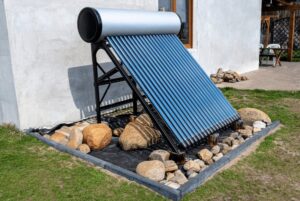
Evacuated tube collector systems use rows of vacuum-sealed glass tubes. The vacuum inside each tube reduces heat loss, making them more efficient, particularly in colder climates or on overcast days. They’re a better fit for areas with cold winters like the Highveld, or for households that want to maximise solar input throughout the year. The tradeoff is cost. They’re meaningfully more expensive than flat plate systems, and if a tube gets cracked or damaged, replacing it adds to ongoing maintenance costs.
Thermosyphon systems work without a pump. Water or heat-transfer fluid moves through the system by natural convection: hot fluid rises, cooler fluid sinks, creating continuous circulation. The storage tank must be positioned above the collectors for this to work, which typically means the tank sits on the roof alongside the panels. It’s a simple and reliable design but adds weight to the roof. Not every roof is structurally suited to this configuration without reinforcement.
Split systems separate the storage tank from the rooftop collectors. The tank is usually installed in the ceiling space or a utility area, with only the collectors on the roof. A small circulation pump moves fluid between them. This design is easier on roof structure and more flexible in terms of tank placement, but it introduces the pump as a component that will eventually need maintenance.
Cost breakdown for South African homes
Here is a realistic picture of what different systems cost, all-in, in South Africa.
Flat plate collector systems (complete, installed):
- 100 to 150 litre: R12,000 to R18,000
- 150 to 200 litre: R16,000 to R25,000
- 200 litre and above: R22,000 to R35,000
Evacuated tube systems (complete, installed):
- 150 litre: R20,000 to R32,000
- 200 litre: R26,000 to R42,000
- Large capacity systems: R35,000 to R55,000+
Installation labour (when quoted separately):
- Standard residential installation: R3,500 to R8,000
- Complex jobs, multi-storey homes, or structural work: R6,000 to R14,000
Additional costs that often aren’t included in initial quotes:
- SANS 10106 certificate of compliance: R500 to R1,500
- Electrical work for backup element connection: R800 to R2,500
- Roof structural reinforcement if required: R1,500 to R6,000
- Plumbing modifications or extra pipework: R500 to R3,000
- Old geyser removal and disposal: R500 to R1,500
- Municipality notification or registration: R200 to R800
Most people who get an initial quote of R18,000 end up paying R23,000 to R26,000 once the extras are properly accounted for. This isn’t unusual and it’s not dishonest, it’s just that some of the additional costs only become clear after a proper on-site assessment. The takeaway is to always ask explicitly what’s included and what isn’t before you sign anything.
How the installation process works
Site assessment. A qualified installer visits your property to assess your roof orientation, pitch, available space, shading, existing plumbing setup, and water pressure. This step is non-negotiable. Any installer quoting you a firm price without visiting the site first is working with incomplete information.
Sizing the system. Based on your household size and hot water demand, the installer recommends a tank capacity. As a rough guide: one to two people can usually manage on 100 litres, three to four people need 150 to 200 litres, and larger households should look at 200 litres or more. Getting this right matters. An undersized system runs out of hot water. An oversized one is an avoidable waste of money.
Quotation and planning. You receive a detailed quote covering equipment, labour, and any additional work. Get at least two or three quotes. Compare not just the price but what’s included in each one, because the scope of work can vary quite a bit between installers.
Installation day. Most residential installations take one full day, sometimes two if complications arise. Collectors are mounted and secured on the roof, the tank is installed or positioned, pipework is connected and insulated, and the backup element is wired in. Your water supply will be off for part of the day.
Commissioning. The system is filled, pressure-tested, and checked thoroughly. The backup element thermostat is set, and any controller or timer is configured. A good installer walks you through how the system works before leaving.
Certification. A SANS 10106 compliance certificate should be issued. Keep it somewhere safe. Your home insurer will ask for it if you ever make a claim related to water damage.
Common Mistakes
Undersizing the system. People sometimes choose a smaller tank to reduce the upfront cost and then find it can’t keep up with demand, especially in winter or on high-usage mornings. This is the most common thing people regret. If you’re between sizes, go bigger.
Using an unqualified installer. Solar water geyser installation involves plumbing, electrical work, and roof mounting. Your installer needs to be registered with the Plumbing Industry Registration Board (PIRB) or the Sustainable Energy Society of Southern Africa (SESSA). An unregistered person doing this work can void the manufacturer warranty, create insurance complications, and leave you with no protection if the installation fails. That’s not a minor risk.
Skipping the compliance certificate conversation. Many homeowners only discover after installation that the certificate wasn’t part of the quote or that the installer couldn’t issue one. Ask about this before work starts, not after.
Assuming every roof is suitable as-is. Older roofs, certain tile types, and north-facing limitations all affect what’s possible without additional work. Shading from trees, walls, or neighbouring structures also plays a bigger role than people expect. Always request an honest roof assessment as part of the site visit.
Not setting the backup element on a timer. If the backup element runs freely whenever the thermostat calls for it, it can consume more electricity than it should. Putting it on a timer set to off-peak hours is a simple adjustment that makes a real difference to monthly costs.
How to choose the right system
Here’s what usually matters when making this decision.
Household size is the most important driver of tank capacity. Don’t try to save money by undersizing. You’ll spend the savings and more on discomfort and workarounds.
Roof suitability. A north-facing roof with good sun exposure and no significant shading is ideal. If your roof isn’t ideal, evacuated tube collectors handle less-than-perfect conditions better than flat plate. Your installer should give you a straight answer on this.
Climate. Flat plate collectors perform well across most of South Africa. Evacuated tubes are worth the extra cost in areas with cold winters or more variable sunshine. Most households in the Western Cape, Gauteng, KwaZulu-Natal, and other sunny regions do perfectly well with flat plate systems.
Water quality. If you’re in an area with hard water, an indirect system with a heat exchanger is worth the additional cost. Hard water deposits inside direct collectors degrade efficiency over time and are expensive to fix.
Budget. A quality flat plate system is the right starting point for most South African households. It’s not the most glamorous option, but it works reliably, costs less, and is easier and cheaper to maintain. Evacuated tubes make sense in specific conditions, but don’t let anyone pressure you into spending more than your situation requires.
Installer credibility. Ask about their registration, how long they’ve been doing solar installations, what warranty they offer on their workmanship, and who services the system after installation. A reputable installer answers these questions without hesitation.
Read more: Solar geyser installation
What the savings actually look like
Heating water with electricity costs the average South African household between R4,500 and R12,000 a year depending on household size, usage, and the current tariff rate. A well-installed solar water geyser typically covers 60% to 80% of that demand with solar energy, reducing annual spend to somewhere between R900 and R4,800.
For a mid-range system costing R22,000 all-in, annual savings of R4,000 to R8,000 translate to a payback period of roughly three to five years. After that, the system continues delivering savings for another fifteen to twenty years. With Eskom tariffs continuing to climb, the payback period only shortens over time.
A solar water geyser is not a magic solution and it won’t eliminate your electricity bill. But for most South African homes it’s a financially sensible long-term investment, and the savings are real. The key is choosing the right system for your household, using a properly qualified installer, budgeting honestly for the full cost, and not cutting corners on either the sizing or the certification. Do those things and you’ll be glad you made the switch.